AI estimate as of October 4, 2025 · verify with a professional before acting
AI-Generated · Verify before acting
Everything on this page is generated by AI for informational purposes only. AI can make mistakes — the AI may misidentify items or misattribute them (artist, maker, brand, designer, origin, era). This is not an official valuation and should not be used for insurance, sale, tax, estate, legal, or lending purposes — or any decision requiring a certified appraisal. It is not an authoritative claim about any person, brand, or rights holder — do not share or rely on it as a factual statement about a third party. Always consult qualified professionals before making financial decisions.
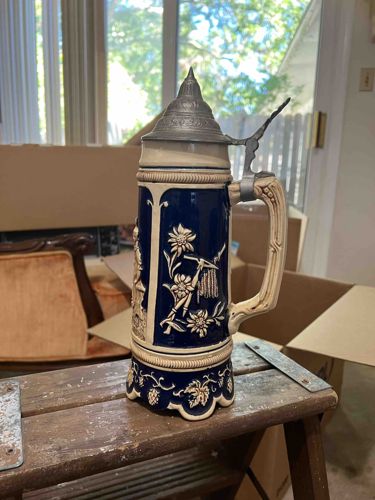
This is a ceramic beer stein, commonly known as a German stein or 'krug'. It features a distinctive dark blue body with raised, cream-colored relief decorations. The main body of the stein is cylindrical, tapering slightly towards the top, and rests on a scalloped base adorned with sculpted grapevines and hop cones. The central decorations on the body appear to depict floral elements, possibly edelweiss, and a traditional rural scene, including what looks like a shepherd's crook or farming tools and possibly a braided rope design. The handle is an integral part of the ceramic body, also in cream-color, with a textured or carved bone-like appearance, showing scrolled contours for a comfortable grip. A prominent feature is the elaborate pewter lid, which is hinged and features an ornate, conical finial at its peak. The lid exhibits intricate embossed or cast designs, adding to its decorative appeal. The thumb lever for opening the lid is also crafted from pewter, displaying a simple yet functional design. The overall construction appears robust and well-executed, indicative of traditional German craftsmanship. The stein's surface shows a glossy finish on the blue glazed areas and a matte to semi-matte finish on the raised cream details. There are no immediately obvious chips, cracks, or significant damage visible in the provided image; however, closer inspection would be required to confirm perfect condition. The pewter lid might show some natural patina or minor tarnishing consistent with age, which is expected for such an item. This piece likely dates from the mid-20th century or earlier, embodying classic Bavarian or German folk art aesthetics.
AI Appraisal Report
I have examined the provided image of this Traditional German Beer Stein with Pewter Lid. Visually, the stein appears to be in very good condition with no immediate chips, cracks, or significant damage evident on the ceramic body. The dark blue glazed finish is glossy, and the cream-colored relief decorations, depicting floral elements, what appears to be a rural scene with tools, and grapevines/hops on the scalloped base, show good detail. The integrated ceramic handle, with its bone-like appearance, seems well-preserved. The pewter lid, a key feature, exhibits intricate embossed designs and an ornate finial, consistent with period craftsmanship. I note that there is likely some natural patina or minor tarnishing on the pewter, which is expected for an item of this age. Authenticity, based solely on visual inspection, appears consistent with a mid-20th century German-made stein, embodying traditional Bavarian folk art aesthetics. The robust construction and detailed ornamentation are hallmarks of quality steins from that era. These types of decorated ceramic steins with detailed pewter lids generally have a steady collector's market. Demand is moderate, driven by collectors of German memorabilia and decorative arts. While not exceedingly rare, a well-preserved example like this holds appeal. Factors impacting value include the condition of both ceramic and pewter, the intricacy of the decoration, and the overall craftsmanship. The lack of visible damage significantly helps its value. However, without a physical inspection, I cannot confirm the absence of hairline cracks, repairs, or manufacturer's marks which would be crucial for precise dating and authentication. I would need to examine the interior for any potential staining, odors, or damage not visible externally, and closely inspect the pewter for maker’s marks or hallmarks. Provenance documentation, if available, would also be invaluable for full authentication and establishing a more definitive value.