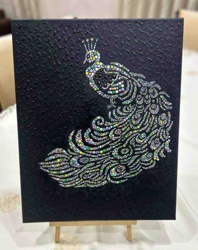
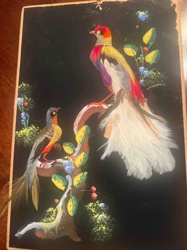
AI estimate as of November 26, 2025 · verify with a professional before acting
AI-Generated · Verify before acting
Everything on this page is generated by AI for informational purposes only. AI can make mistakes — the AI may misidentify items or misattribute them (artist, maker, brand, designer, origin, era). This is not an official valuation and should not be used for insurance, sale, tax, estate, legal, or lending purposes — or any decision requiring a certified appraisal. It is not an authoritative claim about any person, brand, or rights holder — do not share or rely on it as a factual statement about a third party. Always consult qualified professionals before making financial decisions.
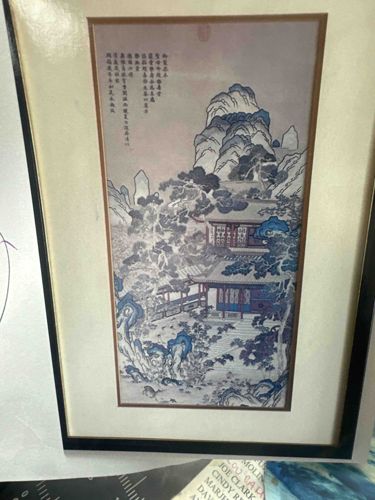
This item is a framed East Asian landscape print, likely a woodblock print or a reproduction thereof, featuring a traditional mountainous and architectural scene. The color palette is predominantly blues, grays, and whites, with subtle hints of reddish-brown on the architectural elements, creating a serene, almost monochromatic effect. The print depicts rugged mountains in the background, likely craggy peaks, rendered with stylized lines and shading. In the mid-ground and foreground, there are multiple traditional East Asian buildings with distinctive tiered roofs, nestled amongst dense foliage, possibly pine trees or similar evergreens, also rendered in shades of blue and gray. A notable feature is the presence of East Asian characters, presumably a poem, inscription, or artist's signature, in the upper left quadrant of the print, arranged in vertical columns. The print itself appears to be matted with a light, possibly off-white or cream-colored mat, which is then enclosed within a simple, dark-colored, likely black, wooden or metal frame. The visible condition suggests some possible fading of the print due to exposure, or it could be intentional soft coloring. There are no obvious tears or major damages visible on the print within the frame, but the resolution does not permit close inspection for minor imperfections. The frame itself appears to be in good condition, with no visible chips or significant wear. The style points towards traditional East Asian landscape art, possibly Chinese or Japanese, and could date from the 20th century, though a more precise age would require examination of the print's medium and additional details not visible in the image. The craftsmanship of the print, with its detailed lines and subtle color variations, suggests a decent quality reproduction or original print.
AI Appraisal Report
I have examined the provided image of this framed East Asian landscape print. Visually, the print appears to be in good condition within its frame, with no obvious tears or significant damage. There's a subtle fading observed, which could be intentional or a result of age and light exposure, adding to its serene aesthetic. The frame itself is simple, dark, and appears well-maintained.
Authenticity is difficult to ascertain from an image alone. Based on the detailed lines and subtle color variations, it suggests a reproduction of decent quality. Without physical inspection, I cannot confirm if it's an original woodblock, a giclée print, or another form of reproduction. The East Asian characters in the upper left quadrant are likely an artist's signature, inscription, or poetic verse, but their interpretation would require expert linguistic analysis.
Market conditions for East Asian landscape prints, particularly reproductions, are generally moderate. While original, rare woodblock prints by renowned artists can fetch significant sums, generalized decorative pieces like this typically appeal to a wider but less specialized market. Comparables would include framed decorative art prints, often found in home decor stores or secondary markets. Demand is consistent for aesthetically pleasing wall art, but rarity is not a factor here without verifiable authenticity as an original work by a known artist.
Factors impacting value significantly include the lack of provenance, the unknown artist, and the inability to confirm the medium of the print. If it were proven to be an original woodblock by a significant artist, the value would increase dramatically. For full authentication, I would need a physical examination to determine the printmaking technique, paper type, and age. Examination of the signature/inscription by a specialized scholar would also be critical. Without these, its value remains as a decorative art print.