AI estimate as of August 9, 2025 · verify with a professional before acting
AI-Generated · Verify before acting
Everything on this page is generated by AI for informational purposes only. AI can make mistakes — the AI may misidentify items or misattribute them (artist, maker, brand, designer, origin, era). This is not an official valuation and should not be used for insurance, sale, tax, estate, legal, or lending purposes — or any decision requiring a certified appraisal. It is not an authoritative claim about any person, brand, or rights holder — do not share or rely on it as a factual statement about a third party. Always consult qualified professionals before making financial decisions.
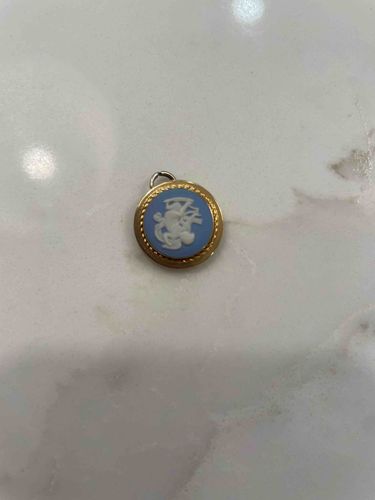
This item is a small, circular charm or pendant, approximately 1 to 1.5 cm in diameter. It features a light blue jasperware-style insert, reminiscent of Wedgwood's classic designs. The insert is adorned with a raised white bas-relief figure, depicting a classical or mythological motif, possibly a cherub or putto-like figure with stylized wings. The detail on the white relief is somewhat abstract but suggests a dynamic pose. The jasperware insert is framed by a gold-toned metal bezel, which appears to have a rope or twisted wire texture along its outer edge, indicating a decorative finish. At the top of the charm, there is a small, silver-toned jump ring, suggesting it is meant to be attached to a necklace, bracelet, or other jewelry item. The metal components show some slight signs of wear consistent with age and use, such as minor surface scratches or dulling of the finish, but no significant damage like dents or breaks. The overall craftsmanship appears good, with clean lines on the bezel and a well-defined relief on the jasperware. This style is characteristic of mid-20th century to contemporary jewelry, often inspired by historical designs. Its small size suggests it could be part of a charm bracelet or a delicate pendant.
AI Appraisal Report
I have examined the provided image of this Jasperware-Style Bas-Relief Charm with Gold-Tone Bezel. Based on my visual assessment, the item appears to be in good overall condition, displaying minor signs of wear consistent with its likely age and use. The jasperware-style insert shows no obvious chips or cracks, and the bas-relief figure is well-defined, though somewhat abstract in its detailing from the image. The gold-toned bezel exhibits minor surface scratches and dulling, which is typical for vintage costume jewelry. The small silver-toned jump ring suggests it was intended for attachment to a bracelet or necklace.
From the image alone, authenticating this piece as true Wedgwood jasperware is not possible without a physical inspection for maker's marks, material analysis, and tactile examination. Similarly, the metal appears to be gold-toned base metal rather than solid gold, a common characteristic of costume jewelry from the mid-20th century onwards. The craftsmanship, while good for its style, does not suggest high-end fine jewelry. Without physical inspection, I cannot confirm the exact composition of the 'jasperware' (e.g., ceramic vs. polymer) or the metal. Provenance documentation would be invaluable for verifying authenticity and origin.
Market conditions for vintage costume jewelry, especially jasperware-style pieces not directly attributed to major brands like Wedgwood, are steady but not commanding high prices. Demand exists for decorative and unique charms, particularly for charm bracelet collectors. However, the lack of definitive branding or precious materials limits its rarity and, consequently, its market value. Comparables typically sell in the costume jewelry market. Factors significantly impacting value include the lack of precious metals, the likely costume nature, and the inability to confirm brand authenticity or specific material composition from an image.
For a full authentication, I would require an in-person examination to look for hallmarks, assess the weight and feel of the materials, perform scratch tests if applicable, and potentially use Magnification for detailed inspection. Without these, the appraisal is limited to its aesthetic and condition as a decorative charm.