AI estimate as of November 28, 2025 · verify with a professional before acting
AI-Generated · Verify before acting
Everything on this page is generated by AI for informational purposes only. AI can make mistakes — the AI may misidentify items or misattribute them (artist, maker, brand, designer, origin, era). This is not an official valuation and should not be used for insurance, sale, tax, estate, legal, or lending purposes — or any decision requiring a certified appraisal. It is not an authoritative claim about any person, brand, or rights holder — do not share or rely on it as a factual statement about a third party. Always consult qualified professionals before making financial decisions.
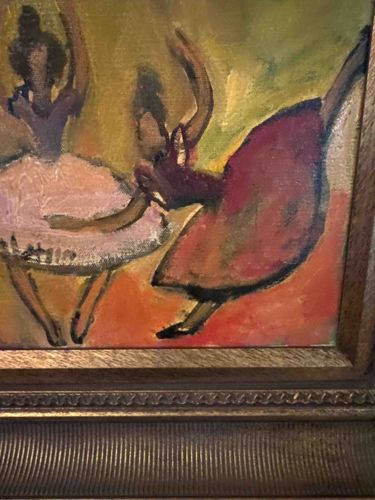
This item is an oil painting or acrylic painting depicting two ballet dancers, rendered in a distinctive expressionistic style. The artwork features a vibrant color palette, dominated by warm tones such as orange, red, and yellow-green in the background, contrasting with the figures. The dancer on the left is partially visible, wearing a light-colored, possibly pink or off-white, tutu, characteristic of ballet attire. Her form is suggested rather than precisely detailed, with hints of dark hair or a bun. The dancer on the right is more prominent, depicted in a dynamic pose, possibly mid-turn or with arms raised. She wears a reddish-brown or deep burgundy costume, which appears to be a dress or tunic rather than a traditional tutu, adding to the unconventional representation. The brushwork throughout the piece is loose and impasto-like, creating texture and a sense of movement and energy. This technique is typical of expressionist art, where emotional impact and subjective interpretation take precedence over realistic depiction. There are no clear visible artist's signatures or marks within the cropped image. The painting is housed within a ornate, possibly carved or molded, wooden frame with a metallic finish, likely brass or bronze-toned, exhibiting some patina or signs of age. The frame features a textured, reeded inner border and a more decorative outer edge, suggesting a traditional framing style that contrasts with the less conventional painting style. The overall condition of the painting appears stable, with no obvious cracks, tears, or significant paint loss visible in the provided image crops. The artwork likely dates from the mid-20th century or later, given its stylistic characteristics. The quality of craftsmanship for the painting lies in its expressive brushwork and bold use of color, while the frame demonstrates attention to decorative detail.
AI Appraisal Report
Upon visual examination of the images provided, I have assessed this original artwork depicting two ballet dancers. The piece is rendered in a vibrant, expressive style, utilizing thick impasto brushwork and a warm, dynamic color palette. The painting's style is reminiscent of mid-20th century Expressionism, focusing on movement and emotion over precise realism. The artwork appears to be in stable condition, with no visible cracking or significant paint loss. It is housed in a decorative, traditionally styled wooden frame with a metallic finish, which shows some age but complements the piece.
The primary factor limiting this artwork's value is the absence of a visible artist's signature or identifying marks. Without attribution to a known artist, the painting must be valued as a decorative work of good quality. The market for unsigned, stylistically appealing paintings is steady, with comparable works by unknown artists from this period often selling in the low to mid-hundreds. Ballet is a consistently popular subject matter, which adds to its decorative appeal and marketability.
To establish a higher value, full authentication would be necessary. An in-person inspection is required to examine the reverse of the canvas for any hidden signatures, gallery labels, or inscriptions. Further research into the artist's identity, supported by provenance documentation such as previous sales records or exhibition history, would be critical. For now, based solely on its decorative merit and skilled execution as an unsigned piece, my appraisal reflects its current market standing.