AI estimate as of September 12, 2025 · verify with a professional before acting
AI-Generated · Verify before acting
Everything on this page is generated by AI for informational purposes only. AI can make mistakes — the AI may misidentify items or misattribute them (artist, maker, brand, designer, origin, era). This is not an official valuation and should not be used for insurance, sale, tax, estate, legal, or lending purposes — or any decision requiring a certified appraisal. It is not an authoritative claim about any person, brand, or rights holder — do not share or rely on it as a factual statement about a third party. Always consult qualified professionals before making financial decisions.
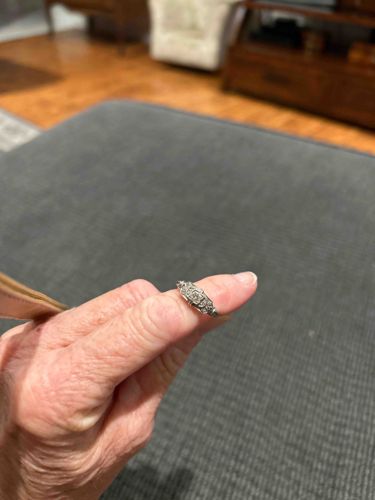
This item is a vintage ring, likely dating from the Art Deco period (approximately 1920s-1930s), crafted from a white-colored metal, most probably white gold or platinum, given the era and color. The ring features a pronounced oblong or navette-shaped setting adorned with multiple small, clear stones, which appear to be diamonds. The central design consists of what looks like three primary diamonds set in a linear fashion, flanked by smaller accent stones, possibly diamond chips, creating a shimmering effect across the face of the ring. The setting itself has intricate filigree or milgrain detailing along its edges, indicative of the precise craftsmanship common in Art Deco jewelry. While the exact size cannot be determined from the image, it appears to be a delicate piece, suitable for a finger. The metal shows a subtle patina consistent with age, suggesting it has not been recently polished to a high shine, which can be desirable for antique pieces. There are no immediately obvious signs of significant damage such as bent prongs or missing stones, though a closer inspection would be required to confirm this. The overall condition appears to be good for its age, retaining its original charm and intricate details. The craftsmanship points to a quality piece, likely hand-finished given the period. There are no visible maker's marks or signatures in this image. Its unique aspects include the distinct Art Deco geometric styling combined with the intricate metalwork, making it a classic example of jewelry from that era.
AI Appraisal Report
I have virtually examined this Vintage Art Deco Diamond and White Gold Ring based on the provided image. My assessment indicates a ring characteristic of the Art Deco period (c. 1920s-1930s). The white metal construction, likely white gold or platinum, and the navette-shaped setting with filigree/milgrain detailing strongly support its Art Deco authenticity. The presence of multiple small, clear stones, appearing to be diamonds, set in a linear fashion with accent stones, is consistent with the era's aesthetic.
From the image, the condition appears good for its age, showing a desirable patina. There are no obvious signs of damage such as missing stones or bent prongs, which is positive for an antique piece. However, without physical inspection, I cannot confirm the exact metal composition (e.g., 10k, 14k, 18k white gold, or platinum) or the precise quality and carat weight of the diamonds. These factors would significantly influence the value.
The market for vintage Art Deco jewelry remains robust, with strong demand for well-preserved, characteristic pieces. The intricate craftsmanship and classic design of this ring contribute to its desirability. Its uniqueness lies in the distinct geometric styling combined with delicate metalwork. Comparable pieces often fetch prices within the estimated range, depending heavily on the precise metal and diamond specifications.
Limitations in authenticity verification from images alone are significant. To fully authenticate and accurately appraise, an in-person examination is crucial. This would allow for:
1. Metal testing to determine karat or platinum content.
2. Detailed assessment of diamond quality (cut, color, clarity) and accurate carat weight measurement.
3. Inspection for any repairs, damage, or wear not visible in the image.
4. Search for any hidden maker's marks or hallmarks. Provenance documentation, if available, would also add significant value and verification.