AI estimate as of September 29, 2025 · verify with a professional before acting
AI-Generated · Verify before acting
Everything on this page is generated by AI for informational purposes only. AI can make mistakes — the AI may misidentify items or misattribute them (artist, maker, brand, designer, origin, era). This is not an official valuation and should not be used for insurance, sale, tax, estate, legal, or lending purposes — or any decision requiring a certified appraisal. It is not an authoritative claim about any person, brand, or rights holder — do not share or rely on it as a factual statement about a third party. Always consult qualified professionals before making financial decisions.
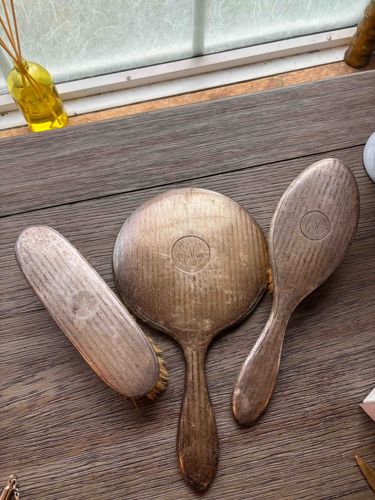
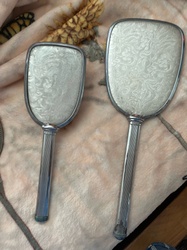
This is a vintage three-piece dressing table set, likely dating from the early to mid-20th century. The set comprises a hand mirror, a hairbrush, and a clothing or hat brush, all featuring silver-plated metal backs with a distinctive ribbed or grooved pattern. Each piece displays a circular cartouche in the center of its back, containing an ornate monogram, possibly 'MW' or 'WM', indicating a personalized touch. The overall color is a dull, tarnished silver-brown, consistent with aged silverplate that has developed a significant patina over time, rather than polished silver. The hand mirror has an oval frame surrounding the (missing) mirror glass and a tapered handle. The hairbrush has natural bristles, which appear somewhat discolored and worn, suggesting frequent use. The third brush, narrower and more elongated, also has bristles, likely for clothing or a different hair-styling purpose. No specific maker's marks or stamps are clearly visible, but the substantial tarnishing and construction suggest a period of manufacturing when such sets were common. The items exhibit considerable wear and tear, including scratches, an uneven patina, and discoloration. The mirror's glass is entirely absent, which significantly impacts its condition and functionality. The bristles on both brushes show signs of age and possible breakage. Despite the condition issues, the pieces retain a classic, ornate style indicative of vanity items from their era, highlighting a certain quality of craftsmanship in their design and construction, even if the base material is not solid silver.
AI Appraisal Report
Upon examining the provided image of this three-piece vintage silver-plated dressing table set, I assess its condition as poor to fair. Authenticity as a period piece from the early to mid-20th century is highly probable given the style, evident tarnishing, and construction methods suggested by the visual cues. The presence of a personalized monogram ('MW' or 'WM') is a charming detail, common for such sets, but does not add significant monetary value unless tied to a notable individual. The most impactful factor on value is the significant wear and tear: the hand mirror is missing its glass entirely, and the bristles on both brushes are discolored and worn, indicating heavy use and lack of maintenance. The dull, tarnished silver-brown patina, while consistent with aged silverplate, is quite heavy and detracts from the aesthetic appeal without proper cleaning and restoration. Without maker's marks, identifying a specific manufacturer or high-end provenance is impossible from the image alone. In terms of market conditions, vintage silver-plated vanity sets are relatively common. While there is a consistent, albeit niche, demand for such items among collectors of vanity ware or period decor, the poor condition significantly limits their appeal. The absence of the mirror's glass is a major detractor, as replacements are often difficult to source and costly to install relative to the item's inherent value. Comparatively, sets in excellent condition with intact mirrors and well-preserved bristles might fetch higher prices (e.g., $100-250), but this set's state places it at the lower end of the market. Its value lies more in its historical decorative appeal than in its functionality or intrinsic material worth. For full authenticity verification and to confirm material composition (e.g., solid silver vs. plate), an in-person examination, specific gravity testing, or XRF analysis would be required. Provenance documentation, if available, could also enhance its historical context and potentially its value, but is absent here. Based on its current condition and material, I estimate this set's value to be in the range of $40-70.