AI estimate as of October 7, 2025 · verify with a professional before acting
AI-Generated · Verify before acting
Everything on this page is generated by AI for informational purposes only. AI can make mistakes — the AI may misidentify items or misattribute them (artist, maker, brand, designer, origin, era). This is not an official valuation and should not be used for insurance, sale, tax, estate, legal, or lending purposes — or any decision requiring a certified appraisal. It is not an authoritative claim about any person, brand, or rights holder — do not share or rely on it as a factual statement about a third party. Always consult qualified professionals before making financial decisions.
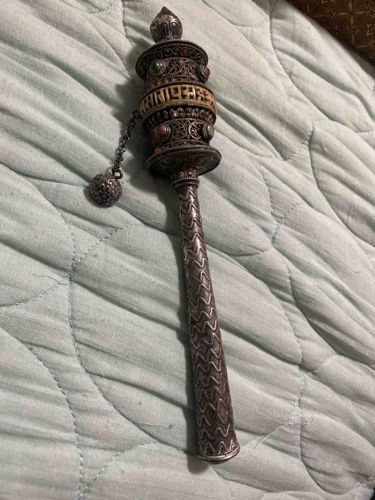
This is a Tibetan Prayer Wheel, also known as a 'Mani Chörlo'. The item features a cylindrical body mounted on a handle, primarily constructed from a silver-toned metal, likely an alloy like white metal or silver given its appearance and the dark patina. The handle, which is not designed to rotate, is elongated and tapered, featuring an embossed or incised zigzag pattern across its entire surface, suggesting a good grip when held. The prayer wheel cylinder itself is intricately decorated with filigree work and what appear to be small, inlaid cabochon stones in various colors such as red, green, and possibly turquoise, though their exact composition is difficult to determine from the image. A central band on the cylinder is of a contrasting lighter material, possibly bone or a light-colored wood, carved or inscribed with what appears to be Tibetan script, likely the mantra 'Om Mani Padme Hum'. The top of the cylinder is crowned with an ornate finial, typical of Buddhist iconography, resembling a stupa or a jewel. Attached to the cylinder by a chain is a small, spherical counterweight or bell, approximately 1-1.5 inches in diameter, which aids in the spinning motion of the prayer wheel. The overall condition shows significant visible wear, particularly a dark, uneven patina suggesting age and handling, with some areas appearing brighter where friction might have occurred. There are no obvious signs of major damage or repair, but the intricate details are somewhat obscured by the patina. The craftsmanship, particularly the filigree and carving, indicates a handmade item, consistent with traditional Tibetan artistry. The item appears to be an older piece, possibly early to mid-20th century or even older, based on the style and discernible wear.
AI Appraisal Report
Upon visual examination of this Tibetan Prayer Wheel, or 'Mani Chörlo,' I find it to be a compelling piece of devotional art. Its construction from a silver-toned metal, likely white metal given the dark, uneven patina and the overall aesthetic, suggests traditional craftsmanship. The embossed zigzag pattern on the handle indicates a focus on both aesthetics and functionality for a secure grip. The intricate filigree work on the cylinder, adorned with what appear to be small cabochon stones in red, green, and possibly turquoise, speaks to significant hand-labor. The central band with Tibetan script, presumably the 'Om Mani Padme Hum' mantra, is a key iconographic element. The ornate finial and the chained counterweight further enhance its authenticity as a traditional prayer wheel.
The condition, characterized by significant wear and a rich patina, strongly suggests age. This wear patterns are consistent with frequent handling over many years. There's no obvious damage or repair, which is a positive factor. The craftsmanship is undoubtedly handmade, aligning with traditional Tibetan artistry. Based on style and wear, I estimate its age to be early to mid-20th century, or possibly older, which contributes to its value as a genuine antique.
Market conditions for such religious artifacts vary, with authentic, older pieces commanding higher prices. Comparables in similar condition, especially those with intricate detail and apparent age, typically fall within this range. Demand exists among collectors of religious artifacts, Buddhist art, and those interested in Himalayan cultural items. Its rarity is moderate; while prayer wheels are common, those exhibiting this level of detail and age are less so. Factors impacting value positively include its apparent authenticity, detailed craftsmanship, and historical patina. The material, while likely white metal rather than sterling silver, does not significantly detract from its value as a cultural artifact.
It is crucial to state that this appraisal is based solely on visual inspection of the provided image. Limitations in authenticity verification are inherent without physical examination. To fully verify the authenticity, exact material composition, and precise age, an in-person examination would be necessary to assess the weight, tactile qualities, and to scrutinize the inlay materials and metal composition under magnification. Furthermore, any provenance documentation would significantly enhance confidence in its history and value. Scientific testing, such as X-ray fluorescence for metal analysis or C-14 dating for organic components (if applicable), could provide definitive authentication beyond visual assessment.