These notes were written by the person who submitted this item. Appraiser.AI has not verified them, and the AI's identification and estimate may rely on them.
AI Estimated Value
Not an official valuation
$100-150
AI estimate as of November 10, 2025 · verify with a professional before acting
AI-Generated · Verify before acting
Everything on this page is generated by AI for informational purposes only. AI can make mistakes — the AI may misidentify items or misattribute them (artist, maker, brand, designer, origin, era). This is not an official valuation and should not be used for insurance, sale, tax, estate, legal, or lending purposes — or any decision requiring a certified appraisal. It is not an authoritative claim about any person, brand, or rights holder — do not share or rely on it as a factual statement about a third party. Always consult qualified professionals before making financial decisions.
This analysis also relies on unverified notes provided by the user, which may be incomplete or inaccurate and could affect the result.
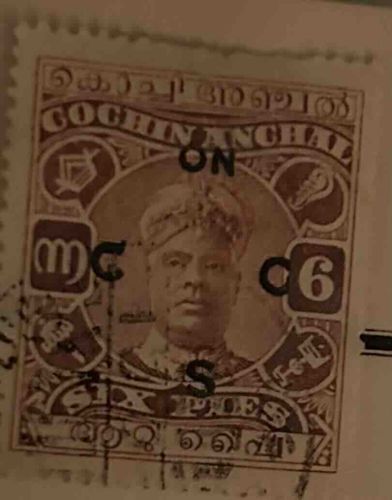
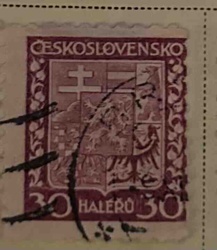
This item is a historical postage stamp from Cochin Anchal, an indigenous postal service of the former princely state of Cochin (now part of India). The stamp features a portrait of a male figure, likely a local ruler or dignitary, centrally positioned within an oval frame. The color of the stamp appears to be a muted brown or sepia tone, indicative of printing processes common in the era of its issuance. The borders of the stamp are intricately designed with scrolling patterns and traditional motifs, framing the central portrait. The denomination '6' is prominently displayed in the upper right corner, along with what appears to be the unit 'Pies' or 'Puthan' in text below the portrait. The inscription 'COCHIN ANCHAL' is visible at the top curved banner, written in English, with additional text in a regional Indian script (likely Malayalam) above and below the English inscription. There are also smaller crests or symbols in the four corners of the central oval design. A distinct feature of this particular stamp is a black overprint 'ON' visible across the upper portion of the portrait and the 'COCHIN ANCHAL' text. This overprint suggests a re-validation or change in postal regulations, which was a common practice for stamps at the time. The stamp shows signs of use with a visible cancellation mark, portions of which are black and appear to be a circular date stamp, indicating it has passed through the postal system. The paper exhibits some discoloration consistent with age, and the edges appear perforated, though the exact condition of the perforations cannot be fully assessed from the image. The overall style suggests an early to mid-20th-century issuance, reflecting the philatelic history of princely states in India before their integration into the Indian Union. The presence of the overprint adds a layer of philatelic interest, potentially indicating a specific, rarer variant of the stamp.
AI Appraisal Report
I've examined the provided image of the Cochin Anchal 6 Puthan (or 6 Pies) Postage Stamp with Overprint. The stamp appears to be a genuine issue from the Cochin Anchal postal service, featuring the characteristic portrait, intricate borders, and bilingual inscriptions. The 'ON' overprint is a key feature, often indicating a specific postal regulation change and can add interest.
From the image, I note the visible "ON" overprint, the '6' denomination, and the 'COCHIN ANCHAL' text. The stamp exhibits a cancellation mark, indicating postal use. Discoloration consistent with age and what appear to be perforated edges are also visible. While the details of the perforation condition are unclear, the cancellation suggests it served its postal purpose.
In terms of market conditions, Cochin Anchal stamps, particularly those with overprints, are collected. However, this specific denomination and overprint combination in a used condition is not exceptionally rare. Comparables for used Cochin Anchal 6 Puthan stamps with this type of overprint typically fall within a modest range, assuming good condition. The visible cancellation, while authenticating use, does obscure part of the design.
Factors impacting value include the clarity of the overprint, the completeness and neatness of the cancellation, and the overall physical condition of the stamp (e.g., condition of perforations, absence of tears, thinning, or repairs). Based on the image, the condition appears good for a used historical stamp, but not pristine.
It is crucial to state that this appraisal is based solely on the provided image. For full authentication and a definitive assessment of condition, an in-person physical examination would be required. This would allow for verification of paper type, watermarks (if any), precise examination of perforations, detection of any hidden flaws or repairs, and a more accurate assessment of the overprint's authenticity and application. Without physical inspection, the complete authenticity cannot be 100% guaranteed.