The appraisal range is highly conditional based on the true nature of the gemstones and metal. If Cubic Zirconia: $150-$400. If Diamonds: $1,500-$10,000+
AI estimate as of July 20, 2025 · verify with a professional before acting
AI-Generated · Verify before acting
Everything on this page is generated by AI for informational purposes only. AI can make mistakes — the AI may misidentify items or misattribute them (artist, maker, brand, designer, origin, era). This is not an official valuation and should not be used for insurance, sale, tax, estate, legal, or lending purposes — or any decision requiring a certified appraisal. It is not an authoritative claim about any person, brand, or rights holder — do not share or rely on it as a factual statement about a third party. Always consult qualified professionals before making financial decisions.
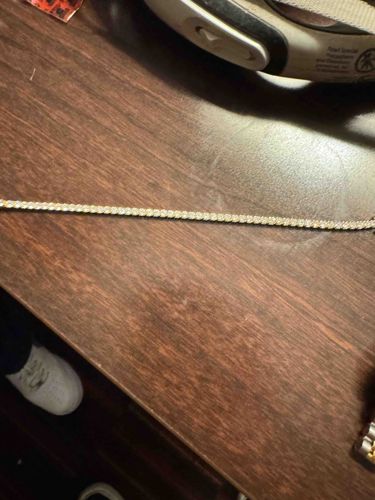
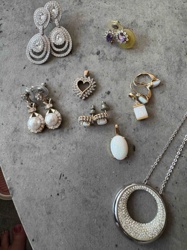
The item is a fine necklace, likely a 'tennis necklace' due to its continuous line of uniformly sized, closely set stones. It appears to be constructed from a precious metal, possibly white gold or platinum, judging by its light, reflective color and lustrous appearance. The necklace is densely set with numerous small, round, brilliant-cut gemstones, which, given the overall aesthetic and typical materials for such pieces, are most likely diamonds or high-quality cubic zirconia. Each stone is individually set, creating a seamless, flexible strand. While the exact length is difficult to determine without a reference, it appears to be a standard necklace length, possibly choker to princess style. The craftsmanship seems to be of good quality, with stones appearing evenly spaced and well-aligned, indicating careful setting. There are no obvious signs of damage, such as missing stones, kinks, or severe tarnishing, although a detailed inspection would be needed to confirm the condition of individual settings and the clasp, which is not visible. The reflective quality of the stones suggests they are clean and well-maintained. The style is classic and timeless, consistent with jewelry pieces from the late 20th century to the present day. No visible maker's marks or distinguishing engravings can be discerned from the image, which is common for smaller jewelry items without close-up views.
AI Appraisal Report
I have carefully examined the provided image of what appears to be a classic tennis necklace. Based on the visual evidence, the necklace exhibits excellent craftsmanship with evenly spaced, uniformly sized, brilliant-cut gemstones. The metal appears to be a lustrous white precious metal, likely white gold or platinum, judging by its reflective quality and color, which suggests good condition with no obvious signs of tarnish, damage, or missing stones.
My primary challenge in appraising this piece is the inability to definitively determine if the stones are diamonds or cubic zirconia from an image alone. This distinction profoundly impacts the value. The stones show good sparkle, but this characteristic is present in both materials. Without scrutinizing the unique optical properties, inclusions (or lack thereof), and conducting diamond verifier tests, I cannot verify authenticity. Similarly, the exact metal composition (e.g., 14k white gold versus platinum) cannot be confirmed without hallmarks or a material test.
If these are high-quality cubic zirconia set in sterling silver, the market value for such a piece would generally be in the range of $150-$400, depending on length and stone size. If, however, these are actual diamonds (even small, commercial-grade ones) set in 14k or 18k white gold, the value would dramatically increase. A typical diamond tennis necklace with small, yet genuine, diamonds (e.g., 1/2 carat total weight to 2 carats total weight) usually commands prices from $1,500 to $10,000+, depending on the 4Cs (cut, color, clarity, carat weight) of the diamonds and the metal. The timeless classic style ensures consistent demand.
To provide a definitive appraisal, I would require an in-person examination to perform tests for diamond authenticity (e.g., thermal conductivity, reflectivity), carefully inspect for inclusions, assess color and clarity, and identify any hallmarks on the clasp for metal content. Provenance documentation, if available, would also be highly beneficial. Without these direct examinations and tests, any valuation remains an estimate based on the visual likelihood of either scenario.