AI Appraisal Estimate

AI-generated estimates · not official valuations

From the user

What was submitted

Photo and notes provided by the user — not generated by AI

Submitted item photo
Submitted photo · May 19, 2026

User's notes

No additional notes provided.

AI analysis below

AI appraisal

AI analysis & estimate

AI-Generated · Verify before acting

Everything below is generated by AI for informational purposes only. AI can make mistakes — the AI may misidentify items or misattribute them (artist, maker, brand, designer, origin, era). This is not an official valuation and should not be used for insurance, sale, tax, estate, legal, or lending purposes — or any decision requiring a certified appraisal. It is not an authoritative claim about any person, brand, or rights holder — do not share or rely on it as a factual statement about a third party. Always consult qualified professionals before making financial decisions.

Read the full disclaimer

AI Identification

·Not independently authenticated·Verify before acting

Polished River Stone (Possible Quartz or Chalcedony)

Geological Specimens

AI Estimated Value

·Not an official valuation·Verify before acting

$5.00 - $15.00

As of May 19, 2026

AI Item Analysis

·AI can make mistakes·Verify before acting
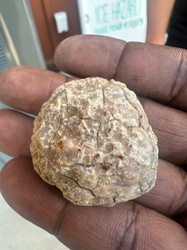
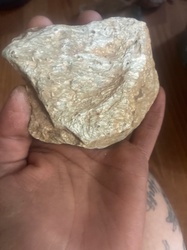
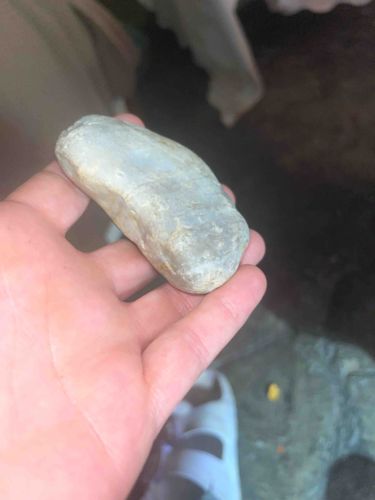
This item is a relatively large, smooth, and oblong-shaped stone held in a human hand for scale. It appears to be roughly 3 to 4 inches in length and possesses a semi-translucent quality, suggesting a high mineral content such as quartz, chalcedony, or a similar silicate mineral. The color palette is composed of muted, earthy tones, predominantly pale gray-white with subtle streaks and patches of tan, beige, and faint blue-gray. The surface texture is notably weathered and water-worn, indicating it likely originated from a high-energy aquatic environment like a riverbed or coastal area. Its edges are rounded and soft, lacking the sharp fractures typically found in freshly broken stone. There are visible surface inclusions, internal stress fractures, and a slightly waxy or dull matte finish typical of unpolished raw mineral specimens. No human-made markings, signatures, or intentional carvings are visible, characterizing it as a natural geological object rather than an artifact or manufactured product. The condition is natural, with numerous small pits and scuffs consistent with environmental rolling and abrasion over a significant geological timeframe. Its density appears high based on the thickness of the piece relative to its overall footprint.

AI Appraisal Report

·AI can make mistakes·Verify before acting
I have virtually examined this hand-sized geological specimen, which displays characteristics of a water-worn silicate, likely a variety of common quartz or macrocrystalline chalcedony. The stone exhibits a high degree of natural tumbling, resulting in a smooth, oblong geometry with muted earth-toned inclusions. From a mineralogical perspective, the specimen appears authentic and unaltered by human carving, showing typical internal stress fractures and a waxy surface luster consistent with river-deposited minerals. In the current market, natural tumbled stones of this variety are widely available and possess low rarity. Comparable specimens are typically sold by weight in rock shops or gift stores as decorative 'river stones' or 'pocket stones.' The lack of vibrant crystallization, rare mineral associations, or archaeological significance (such as use as a prehistoric tool or debitage) keeps the valuation at a nominal level. Factors such as the size and the pleasing tactile shape provide slight aesthetic appeal, but do not elevate it to the status of a collector-grade mineral specimen. Significant limitations exist when appraising via imagery. A definitive identification of the mineral species—distinguishing between high-grade quartzite and weathered chalcedony—would require a Mohs hardness test and specific gravity measurement. Furthermore, while the specimen appears natural, an in-person examination under a loupe is necessary to rule out synthetic resin coatings sometimes applied to mimic a wet look. For full authentication, provenance regarding the collection site would be required to determine if the stone holds any specific regional geological interest.

Related Tags

Explore similar items and categories

Get your items appraised

Instant estimates of your treasures with AI-powered appraisals

Browse More Appraisals