AI Appraisal Estimate

AI-generated estimates · not official valuations

From the user

What was submitted

Photo and notes provided by the user — not generated by AI

Submitted item photo
Submitted photo · May 18, 2026

User's notes

Indian vintage

AI analysis below

AI appraisal

AI analysis & estimate

AI-Generated · Verify before acting

Everything below is generated by AI for informational purposes only. AI can make mistakes — the AI may misidentify items or misattribute them (artist, maker, brand, designer, origin, era). This is not an official valuation and should not be used for insurance, sale, tax, estate, legal, or lending purposes — or any decision requiring a certified appraisal. It is not an authoritative claim about any person, brand, or rights holder — do not share or rely on it as a factual statement about a third party. Always consult qualified professionals before making financial decisions.

Note

This analysis also relies on unverified notes provided by the user, which may be incomplete or inaccurate and could affect the result.

Read the full disclaimer

AI Identification

·Not independently authenticated·Verify before acting

Vintage Ravi Varma Style Framed Print

Indian Vintage Art

AI Estimated Value

·Not an official valuation·Verify before acting

$150 - $350

As of May 18, 2026

AI Item Analysis

·AI can make mistakes·Verify before acting
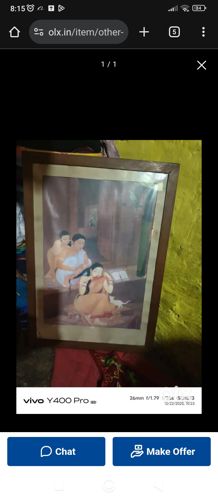
This is a vintage Indian mythological or domestic print housed in a traditional wooden frame with a simplistic flat profile. The artwork depicts three female figures in a domestic interior setting, evocative of the realistic oily style popularized by Raja Ravi Varma in the late 19th and early 20th centuries. The central figure is seated on the floor, while two others are positioned behind her, set against a backdrop of architectural elements and pillars typical of high-class Indian households of the period. The palette consists of warm earth tones, soft whites, and flesh tones, creating a serene, intimate atmosphere. The print appears to be a mass-produced lithograph or oleograph, which were common in Indian homes from the 1920s through the mid-20th century. Physically, the item shows signs of age congruent with its vintage status, including light foxing on the paper and some potential fading due to UV exposure. The frame is basic, possibly teak or a similar regional hardwood, showing minor scuffs and a dull patina. There are no immediate maker's marks visible in the low-resolution image, but such pieces were often printed by the Ravi Varma Press or similar commercial lithographic printers in Mumbai or Germany. The overall composition displays the intersection of Indian cultural themes with Western academic realism.
AI Appraisal Report

·AI can make mistakes·Verify before acting
Based on my visual examination of this vintage lithograph, the piece is a fine example of the Ravi Varma school of popular prints, likely dating from the 1930s to the 1950s. The composition utilizes the Western academic realism pioneered by the Ravi Varma Press, depicting a domestic 'Zenana' scene with attention to drapery and interior architecture. The condition shows character-appropriate wear; the minor foxing and UV fading are typical for paper ephemera of this era in the Indian subcontinent. The frame appears to be a period-correct regional hardwood, which adds to its decorative appeal but remains a utility framing rather than a high-value antique in itself. Market demand for these oleographs has seen a steady rise among collectors of Indian 'Calendar Art' and colonial-era memorabilia. Recent auction results for unsigned, mid-sized lithographs in this condition generally fall within the $150 to $350 range. Higher values are reserved for early first-pressings from the Lonavala or Ghatkopar periods. Limitations of this appraisal include the inability to inspect the paper's watermark or the printing dot pattern under magnification, which is necessary to distinguish an authentic early 20th-century oleograph from a mid-century reprint. A physical inspection would also determine if the foxing is active mold or stable staining. To finalize authentication, I would require access to any original purchase receipts or provenance history, and a removal from the frame to check for printer margins and publisher stamps often concealed by the rabbet.

Get your items appraised

Instant estimates of your treasures with AI-powered appraisals

Browse More Appraisals