AI estimate as of July 20, 2025 · verify with a professional before acting
AI-Generated · Verify before acting
Everything on this page is generated by AI for informational purposes only. AI can make mistakes — the AI may misidentify items or misattribute them (artist, maker, brand, designer, origin, era). This is not an official valuation and should not be used for insurance, sale, tax, estate, legal, or lending purposes — or any decision requiring a certified appraisal. It is not an authoritative claim about any person, brand, or rights holder — do not share or rely on it as a factual statement about a third party. Always consult qualified professionals before making financial decisions.
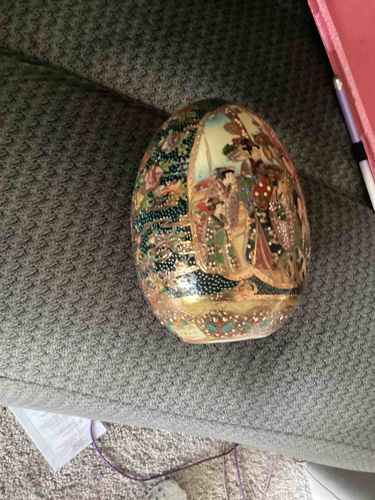
This item is an ornate decorative egg, likely crafted from ceramic or porcelain, given its smooth, glossy appearance and intricate decoration. The egg shape is symmetrical and substantial, suggesting it's designed to be a freestanding display piece. Its primary color palette features a dark teal or possibly a very deep green background, heavily embellished with metallic gold accents. One side of the egg showcases a main pictorial panel depicting a scene with several figures, presumably in traditional Japanese attire, suggesting a cultural or historical narrative. These figures are rendered with delicate brushwork and appear to be dressed in kimonos with various patterns and colors including reds, greens, and browns. Surrounding this panel, and covering the majority of the egg's surface, is a highly detailed pattern of tiny, colorful enamel 'jewels' or dots in shades of red, blue, green, and white, set against the gold and teal background. This meticulous speckling, combined with floral motifs, gives the piece a rich, almost mosaic-like texture. The gold is applied liberally, outlining shapes and creating a shimmering effect. The craftsmanship appears to be of high quality, indicative of Satsuma ware or a similar Japanese ceramic tradition known for its elaborate enameling and gilt decoration. There are no immediately visible signs of significant damage such as chips or cracks, although subtle wear to the gilt or minor surface abrasions might be present upon closer inspection, consistent with its age and handling. The aesthetic strongly points to a late 19th to early 20th-century Japanese origin, a period when such decorative ceramic pieces were popular for export and display.
AI Appraisal Report
This ornate decorative egg, likely of ceramic or porcelain, appears to be a fine example of Japanese Satsuma-style ware, probably dating from the late 19th to early 20th century. Based on the provided image, the condition appears excellent, with no visible chips or cracks. The intricate decoration, featuring a dark teal background, extensive metallic gold accents, and a pictorial panel with figures in traditional Japanese attire, is characteristic of the style. The highly detailed 'jewel' speckling and floral motifs suggest high-quality craftsmanship, indicative of a piece made for export or display during a period when such items were highly sought after.
Market conditions for Japanese Satsuma ware remain steady, with strong demand for well-preserved, finely decorated examples. Comparable pieces of this size and decorative complexity typically achieve values in the mid-to-high hundreds at auction and retail. The rarity of such a complete and undamaged piece in this specific egg form also contributes positively to its value. Factors significantly impacting value include the detailed narrative scene and the rich, multi-layered enamel and gilt decoration.
It is crucial to note that this assessment is based solely on visual examination of the provided image. While the stylistic cues strongly suggest authenticity, a definitive verification would require an in-person examination to assess the tactile quality of the glaze, the precise nature of the enamels, and the application of the gilt. Provenance documentation, if available, would further enhance authentication and value. Scientific testing for material composition could also provide confirmation, though this is rarely necessary for ceramic appraisal unless there are serious doubts about authenticity.