These notes were written by the person who submitted this item. Appraiser.AI has not verified them, and the AI's identification and estimate may rely on them.
AI Estimated Value
Not an official valuation
$250 - $450
AI estimate as of September 24, 2025 · verify with a professional before acting
AI-Generated · Verify before acting
Everything on this page is generated by AI for informational purposes only. AI can make mistakes — the AI may misidentify items or misattribute them (artist, maker, brand, designer, origin, era). This is not an official valuation and should not be used for insurance, sale, tax, estate, legal, or lending purposes — or any decision requiring a certified appraisal. It is not an authoritative claim about any person, brand, or rights holder — do not share or rely on it as a factual statement about a third party. Always consult qualified professionals before making financial decisions.
This analysis also relies on unverified notes provided by the user, which may be incomplete or inaccurate and could affect the result.
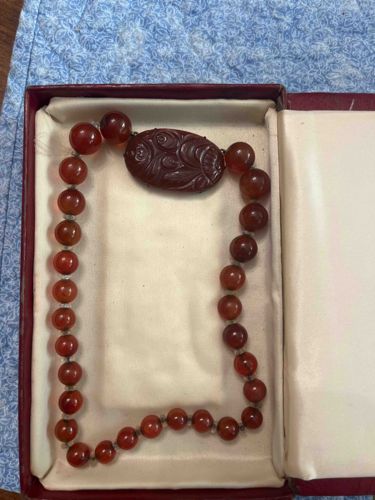
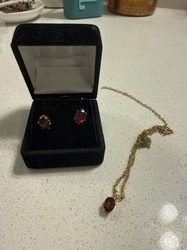
This item is a necklace composed of spherical beads and a central carved, oval-shaped plaque, presented in what appears to be its original fitted jewelry box. The beads are a warm, translucent reddish-brown color, consistent with materials such as carnelian, amber, bakelite, or other resinous plastics. While individual bead sizes vary slightly, they appear to range from approximately 8mm to 12mm in diameter, strung together with small, possibly silver-toned or white metal, spacers between each bead, adding a delicate contrast and spacing effect. The central plaque is significantly larger and more opaque, exhibiting a rich, dark brown hue. It features intricate, raised carving depicting floral or foliate motifs, possibly stylized roses or similar organic designs, with a notable 'swirl-like' pattern at its edges. The carving demonstrates a good level of detail and craftsmanship, with smooth, rounded edges to the carved elements, suggesting a hand-carved or meticulously molded piece. The overall condition of the beads appears good, with a visible patina or slight surface wear consistent with age and use. The stringing material is not visible but appears secure within the box. The presence of such a piece returning from Germany during WWII suggests a possible European origin and an age placing it in the Art Deco to mid-century period (1920s-1940s) for Bakelite or other early plastics, or potentially older if it is natural amber or carnelian, which were popular across many eras. The deep, rich color and translucent quality of the beads, combined with the detailed central carving, indicate a potentially valuable piece, depending on material identification. The presentation in a box suggests it was cherished.
AI Appraisal Report
Upon visual examination of this Carved Brown Resin (possibly Bakelite or Amberoid) Bead Necklace with Central Carved Plaque, I observe a charming piece with considerable aesthetic appeal. The necklace presents in good condition, showing expected patina and minor surface wear consistent with its likely age and material. The beads exhibit an attractive reddish-brown translucence, and the central carved plaque displays intricate floral or foliate motifs with a 'swirl-like' edge, indicating good craftsmanship. The inclusion of a fitted jewelry box suggests the piece was valued. The provenance of returning from Germany during WWII points towards an Art Deco to mid-century European origin, a period when Bakelite and other early plastics were popular. The primary factor impacting value here is the material identification. If the beads and central plaque are indeed Bakelite or a similar phenolic resin, its value falls within the lower end of the given range. Should scientific testing reveal it to be natural amber, particularly of a higher quality, its value could significantly increase, potentially exceeding the high end of this estimate. Conversely, if it is a more common, later plastic, the value would be at the lower end. Market demand for early plastics and carved resin jewelry is stable, with collectors appreciating well-preserved, period-correct examples. Rarity is moderate; while carved resin pieces are not unique, those with fine detail and good condition, especially with provenance, are sought after. To definitively confirm material authenticity, in-person examination, specific gravity tests, and potentially infrared spectroscopy would be necessary to distinguish between Bakelite, amber, and other resins. Without this, I cannot confirm the exact material, which is a significant limitation in providing a more precise valuation.