Oval Cluster Cocktail Ring with Marquise-Cut Center Gemstone
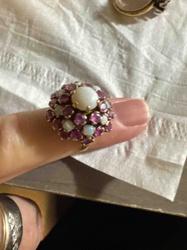
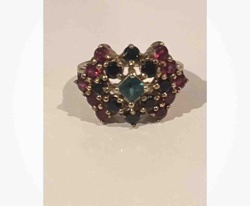
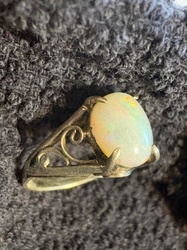
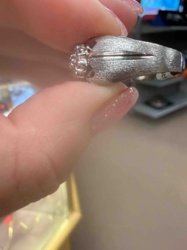
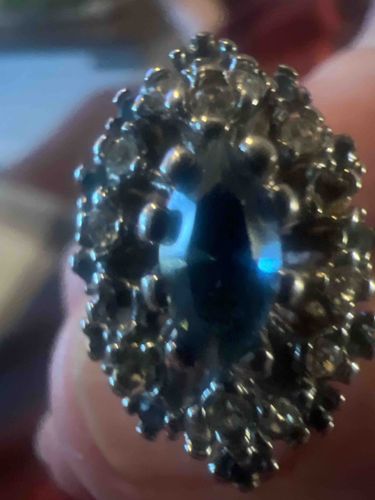
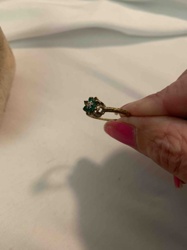
This is a vintage-style cocktail ring features a prominent marquise-cut center gemstone, appearing in a deep teal or sapphire blue hue, set within an ornate oval-shaped halo cluster. The secondary stones are small, colorless round-cut gems (commonly cubic zirconia or small diamonds) that are individually held in a prong-heavy 'starburst' or tiered cluster setting. The mounting appears to be white gold or sterling silver given the cool-toned metallic luster, though there is visible darkening or tarnish which could indicate silver or base metal with plating. The craftsmanship identifies as a late 20th-century aesthetic, likely 1970s or 1980s, characterized by the high-profile tiered setting known as a 'princess' or 'beehive' cluster. Visible condition issues include significant dust and possible surface residue within the crevices of the prongs, suggesting it has been worn frequently without deep ultrasonic cleaning. There is visible wear to the facets of the center stone, particularly along the table edges, which might suggest a softer material like glass or sapphire rather than diamond. No maker's marks are visible in the provided view, but the overall construction is typical of mass-market fine or bridge jewelry from the mid-to-late mid-century era.
AI-Generated Appraisal Disclaimer
Estimated Value
$150 - $450
Basic Information
Category
Fine Jewelry / Vintage Rings
Appraised On
February 26, 2026
Estimated Value
$150 - $450
Item Description
This is a vintage-style cocktail ring features a prominent marquise-cut center gemstone, appearing in a deep teal or sapphire blue hue, set within an ornate oval-shaped halo cluster. The secondary stones are small, colorless round-cut gems (commonly cubic zirconia or small diamonds) that are individually held in a prong-heavy 'starburst' or tiered cluster setting. The mounting appears to be white gold or sterling silver given the cool-toned metallic luster, though there is visible darkening or tarnish which could indicate silver or base metal with plating. The craftsmanship identifies as a late 20th-century aesthetic, likely 1970s or 1980s, characterized by the high-profile tiered setting known as a 'princess' or 'beehive' cluster. Visible condition issues include significant dust and possible surface residue within the crevices of the prongs, suggesting it has been worn frequently without deep ultrasonic cleaning. There is visible wear to the facets of the center stone, particularly along the table edges, which might suggest a softer material like glass or sapphire rather than diamond. No maker's marks are visible in the provided view, but the overall construction is typical of mass-market fine or bridge jewelry from the mid-to-late mid-century era.
Get Your Items Appraised
Instant estimates of your treasures with AI-powered instant appraisals