AI estimate as of August 2, 2025 · verify with a professional before acting
AI-Generated · Verify before acting
Everything on this page is generated by AI for informational purposes only. AI can make mistakes — the AI may misidentify items or misattribute them (artist, maker, brand, designer, origin, era). This is not an official valuation and should not be used for insurance, sale, tax, estate, legal, or lending purposes — or any decision requiring a certified appraisal. It is not an authoritative claim about any person, brand, or rights holder — do not share or rely on it as a factual statement about a third party. Always consult qualified professionals before making financial decisions.
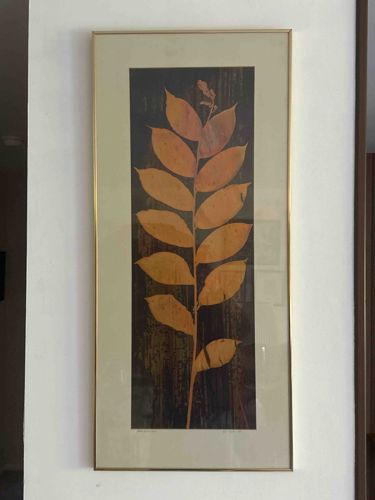
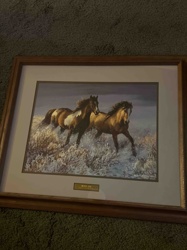
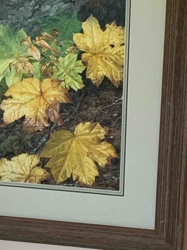
This is a framed art print featuring a botanical design, specifically a single branch with numerous leaves. The print itself has a vertical orientation, showcasing a central stem with leaves arranged bilaterally, tapering slightly towards the top. The leaves exhibit a range of warm, autumnal hues, predominantly oranges and browns, suggesting a naturalistic palette. The background of the print appears to be a dark, textured surface, possibly mimicking wood grain or a similar organic material, providing a strong contrast to the lighter leaves. The overall aesthetic of the print leans towards a naturalistic or botanical art style, common in contemporary and modern décor. The print is housed within a rectangular frame with a narrow, metallic-toned border, likely a gold or brass finish, which complements the warm tones of the artwork. Surrounding the visible artwork within the frame is a wide, light-colored mat board, likely cream or off-white, which provides visual separation between the print and the frame, enhancing the presentation. The frame and mat appear to be in good condition with no immediately visible damage or significant wear, though minor dust accumulation might be present. The construction of the frame appears to be standard, possibly metal or wood with a metallic finish. The clear pane covering the print (glass or acrylic) reflects ambient light, indicating its presence for protection. No specific artist signatures, edition numbers, or manufacturing marks are discernible from the provided images, which would be essential for a full appraisal. Given the clean lines and botanical subject, it likely dates from the late 20th century to early 21st century.
AI Appraisal Report
I have examined the provided image of the framed botanical print of autumn leaves. The item appears to be in good overall condition, with no visible damage to the print, mat, or frame. The metallic-toned frame and wide, light-colored mat board present the autumnal leaf print effectively. The print itself, featuring warm orange and brown hues against a dark background, suggests a naturalistic botanical art style. This type of decorative art is popular and fits well within contemporary and modern decor.
From a visual perspective, the authenticity of the print as an original piece versus a reproduction cannot be definitively determined. It appears to be a mass-produced print rather than a unique artwork. Market conditions for decorative botanical prints are generally stable, with a broad demand for aesthetically pleasing and non-controversial subjects. Comparables in the retail market for framed prints of this nature typically range from low to mid-tier pricing, depending on size, framing quality, and potential artist attribution.
Factors significantly impacting value include the print's originality (e.g., giclée vs. offset lithograph), the artist's reputation, if any, and the edition size if applicable. Without any visible artist signatures, edition numbers, or discernible manufacturing marks, the item's valuation is based purely on its decorative appeal and general market rates for similar items. Its rarity is likely low given its probable mass-produced nature.
Limitations in authenticity verification from images alone are significant. For full authentication and a more precise appraisal, an in-person examination would be crucial to inspect the print's medium, paper quality, printing technique, and to search for any hidden marks or signatures. Provenance documentation (e.g., purchase receipts, artist's certificates) would be essential to verify its origin and potential artist. Scientific testing, such as pigment analysis, would be unnecessary for a common decorative print like this but could be employed for valuable original artworks.