AI estimate as of September 24, 2025 · verify with a professional before acting
AI-Generated · Verify before acting
Everything on this page is generated by AI for informational purposes only. AI can make mistakes — the AI may misidentify items or misattribute them (artist, maker, brand, designer, origin, era). This is not an official valuation and should not be used for insurance, sale, tax, estate, legal, or lending purposes — or any decision requiring a certified appraisal. It is not an authoritative claim about any person, brand, or rights holder — do not share or rely on it as a factual statement about a third party. Always consult qualified professionals before making financial decisions.
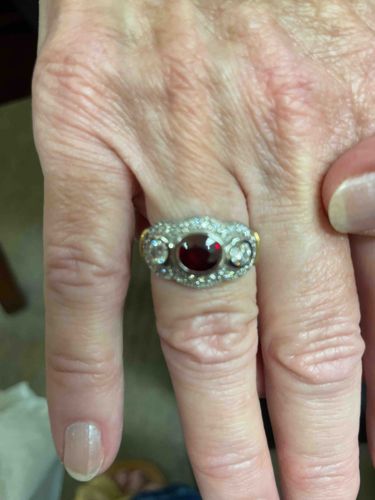
This item is a ring, appearing to be crafted from metal, likely gold given the subtle yellow undertones visible on the sides of the band, contrasting with a rhodium-plated or white gold top setting for the diamonds. The central stone is a prominent oval-shaped, deep red gemstone, strongly resembling a ruby, set horizontally. It is flanked on either side by a single, round brilliant-cut diamond, creating a classic three-stone design. The shoulders and surrounding areas of the principal stones are meticulously pave-set with numerous smaller, round brilliant diamonds, which provide significant sparkle and enhance the visual impact of the ring. The overall shape of the setting is a gentle oval or elongated cushion, with a slightly raised profile. The craftsmanship appears to be of good quality, with stones set securely and exhibiting good brilliance, particularly the smaller pave diamonds. The metalwork shows a smooth finish, although some minor wear consistent with regular use might be present, indicated by slight dulling of the metal surface in some areas, though not detracting from its overall appeal. No visible manufacturing marks or signatures are discernable from the image. The style suggests it could be an antique or vintage piece, possibly from the mid-20th century, or a contemporary reproduction in a classic style. The significant number of pave-set diamonds indicates a high level of detail and potential value.
AI Appraisal Report
Based on my visual examination of the provided image, this is a charming three-stone ruby and diamond ring. The overall condition appears good, with stones securely set and exhibiting a pleasing brilliance, particularly among the numerous pave diamonds. The central stone, an oval-shaped deep red gemstone, presents very much like a natural ruby, flanked by two seemingly well-cut round brilliant diamonds. The use of both yellow and white-toned metals (likely rhodium-plated white gold for the top setting) suggests a thoughtful design intended to highlight the stones. The extensive pave setting adds significant decorative value and sparkle. While some minor wear to the metal surface is discernible, it is consistent with regular use and does not detract significantly from its aesthetic appeal.
Market conditions for ruby and diamond jewelry remain robust, especially for classic three-stone designs. The considerable number of pave diamonds enhances its perceived luxury and contributes to its value. Demand for such pieces is steady, as they are popular for anniversaries, engagements, or as statement rings. Rarity is moderate, given the prevalence of similar designs, though the quality of the central ruby (if natural and untreated) would be a significant differentiator.
Factors significantly impacting value include the carat weight, clarity, and color of the central ruby and the two flanking diamonds, as well as the total carat weight and quality of the pave diamonds. Without an in-person examination, I cannot definitively confirm the authenticity of the ruby (e.g., natural vs. synthetic, treated vs. untreated) or the exact quality grades of any of the diamonds. To fully authenticate and accurately value this ring, an in-person inspection would be essential to assess diamond clarity and color, gemological testing of the ruby, measurement of all stones for precise carat weight estimation, and a thorough examination for any hidden marks or repairs. Provenance documentation, if available, would also be highly beneficial.