AI estimate as of November 21, 2025 · verify with a professional before acting
AI-Generated · Verify before acting
Everything on this page is generated by AI for informational purposes only. AI can make mistakes — the AI may misidentify items or misattribute them (artist, maker, brand, designer, origin, era). This is not an official valuation and should not be used for insurance, sale, tax, estate, legal, or lending purposes — or any decision requiring a certified appraisal. It is not an authoritative claim about any person, brand, or rights holder — do not share or rely on it as a factual statement about a third party. Always consult qualified professionals before making financial decisions.
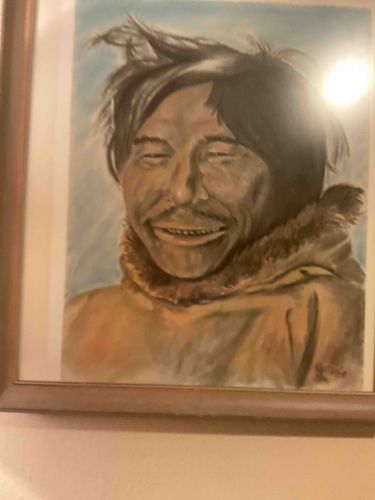
This item is a framed portrait, likely a pastel or charcoal drawing, depicting an Inuit man from the chest up, captured in a moment of broad, genuine laughter or smile. The man predominately features dark, somewhat unruly hair that stands up in places, contrasting with his dark, weathered skin tone. His eyes are closed in mirth, and his face is heavily lined, suggesting age and character. He is wearing what appears to be a traditional parka or fur-lined jacket, indicated by the prominent brown, fluffy fur collar around his neck and the earthy tones of the garment. The background is a soft, light blue, possibly representing a cold, clear sky, which provides a stark yet complementary contrast to the warm tones of his skin and clothing. The artwork is housed within a simple, light-colored wooden frame, possibly a natural wood finish, behind glass or acrylic glazing. The visible condition includes glare on the surface of the glazing due to the lighting in the room, which slightly obscures parts of the image, particularly to the right. There are no immediately obvious signs of damage to the artwork itself, such as tears, creases, or significant fading, although the quality of the image makes a definitive assessment challenging. The style appears to be realistic with an emphasis on expressive portraiture, capturing human emotion and character. The craftsmanship is evident in the detailed rendering of facial features and the texture of the fur. Given the subject matter and style, this piece likely dates from the mid to late 20th century, consistent with a period when such cultural representations became more common in art.
AI Appraisal Report
I have examined the provided image of the framed portrait, "Portrait of an Inuit Man Smiling." Based on this visual assessment, the artwork appears to be a well-executed pastel or charcoal drawing from the mid to late 20th century. The subject's joyous expression and the detailed rendering of his features and traditional attire contribute significantly to its artistic merit.
The condition of the artwork itself appears very good, showing no obvious signs of damage such as tears, creases, or significant fading, although the glare on the glazing limits a definitive assessment. The simple wooden frame is appropriate for the piece and in good condition. The background's soft blue creates a pleasing contrast with the subject's warm tones.
From a market perspective, expressive portraiture, especially of diverse cultural subjects, has a consistent, albeit niche, demand. While not bearing the signature of a widely recognized artist (which I cannot discern from the image), the piece's strong emotional appeal and technical skill should attract buyers. Comparable works by unestablished regional artists specializing in cultural portraiture typically fetch between $300 and $600.
Limitations to authenticity verification exist without physical examination. I cannot definitively confirm the medium (pastel vs. charcoal) or rule out minor imperfections obscured by the glare. Furthermore, verifying the artist's identity and provenance (history of ownership) is impossible from an image alone. An in-person inspection would allow for a precise assessment of the medium, condition, and any artist's signature, significantly impacting value. Tracing provenance through documentation would provide crucial authentication and potentially increase market value.