AI estimate as of July 24, 2025 · verify with a professional before acting
AI-Generated · Verify before acting
Everything on this page is generated by AI for informational purposes only. AI can make mistakes — the AI may misidentify items or misattribute them (artist, maker, brand, designer, origin, era). This is not an official valuation and should not be used for insurance, sale, tax, estate, legal, or lending purposes — or any decision requiring a certified appraisal. It is not an authoritative claim about any person, brand, or rights holder — do not share or rely on it as a factual statement about a third party. Always consult qualified professionals before making financial decisions.
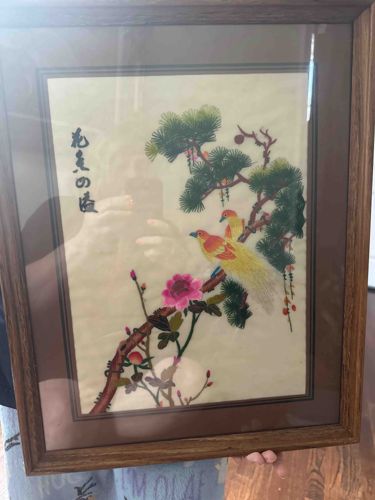
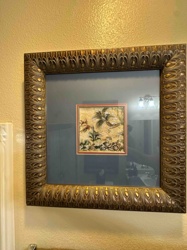
This item is a framed embroidered silk art piece, likely of East Asian origin, depicting two vibrant pheasants or similar exotic birds perched on a branch, possibly pine, with an accompanying blooming floral element, specifically a pink peony or rose. The embroidery is executed with fine silk threads, demonstrating a high degree of craftsmanship, typical of Su embroidery or similar traditional Chinese/Japanese silk embroidery techniques, where threads are often split into minute strands to achieve subtle shading and realistic textures, particularly visible in the birds' plumage. The colors are rich and well-preserved, featuring bright yellows, oranges, and reds for the birds, deep greens for the pine needles, and a striking pink for the flower. The background fabric appears to be a light cream or ivory silk, which has likely mellowed with age, possibly showing some light discoloration or foxing, though this is difficult to ascertain precisely due to reflections on the glass. The entire piece is presented under glass, which shows reflections from the surrounding environment, in what appears to be a simple, rectangular wooden frame with a medium-brown finish, possibly oak or a similar grain. The frame features a visible inner dark brown mat or liner, which effectively separates the embroidery from the frame itself. In the upper left quadrant, there are vertical characters, likely Chinese or Japanese calligraphy, possibly a signature, date, or poetic inscription, adding to the cultural context of the piece. The overall condition appears good given its age, with no obvious tears or loose threads visible through the glass, though the frame shows some minor wear consistent with handling and age. The precise age is difficult to determine without further examination, but the style suggests mid-20th century or earlier.
AI Appraisal Report
This framed silk embroidery, depicting two pheasants and a peony, exhibits the fine craftsmanship characteristic of East Asian textile art, likely Chinese or Japanese. The "split thread" technique, suggested by the detailed plumage, points to a high level of artistry in its execution. Colors remain vibrant, and the overall composition is aesthetically pleasing. While the condition appears good through the glass, subtle discoloration or foxing of the silk could be present, common with age. The simple wooden frame and inner mat are appropriate for the piece and show minor wear consistent with its likely age. The vertical calligraphy in the upper left is a crucial element for determining origin, artist, and possibly date, significantly impacting value, but requires translation and expert analysis.
From the image alone, definitive authentication of the silk's age, specific origin, or the artist is challenging. An in-person examination is critical to assess the silk's texture, condition (particularly for fading, tears, or repairs not visible through glass), and the exact embroidery technique. Microscopic analysis of threads could confirm fineness and natural dyes, if applicable. Full authentication would also require translation and expert analysis of the calligraphy, provenance documentation (e.g., prior ownership history, exhibition records), and potentially comparative analysis with documented examples from known workshops or artists. Without this, I cannot confirm it as high-end Su embroidery or a definitive dating beyond "mid-20th century or earlier."
Market demand for well-preserved, authentic East Asian silk embroideries remains steady, with higher demand for masterworks or pieces with significant historical provenance. Similar decorative pieces without specific attribution typically sell for a moderate range, while attributed, authenticated works can command significantly more. The calligraphy's content is key to unlocking its potential.
Key value drivers are craftsmanship, condition, and importantly, the content and translation of the calligraphy. Limitations include visual access through glass and lack of provenance.