AI estimate as of August 29, 2025 · verify with a professional before acting
AI-Generated · Verify before acting
Everything on this page is generated by AI for informational purposes only. AI can make mistakes — the AI may misidentify items or misattribute them (artist, maker, brand, designer, origin, era). This is not an official valuation and should not be used for insurance, sale, tax, estate, legal, or lending purposes — or any decision requiring a certified appraisal. It is not an authoritative claim about any person, brand, or rights holder — do not share or rely on it as a factual statement about a third party. Always consult qualified professionals before making financial decisions.
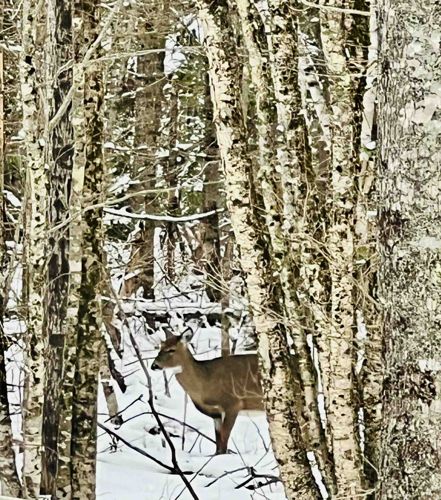
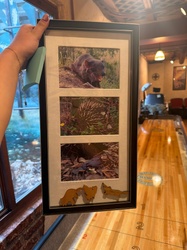
The item is a photographic image depicting a wild deer, likely a White-tailed Deer (Odocoileus virginianus), standing in a snow-covered sparse forest environment. The deer is positioned centrally in the lower half of the frame, partially obscured and framed by numerous slender tree trunks, giving the impression of it being camouflaged or peeking through the foliage. Its coat is a drab brownish-gray, typical for winter pelage, providing excellent camouflage against the muted winter colors. The deer's profile is visible, showing its head, neck, and the majority of its body, with its tail being indistinct. The ears are short and pointed, and the muzzle is dark. It appears to be an adult or sub-adult, with no visible antlers, suggesting it might be a doe or a young buck. The forest consists primarily of bare deciduous trees, possibly birch or aspen given their light-colored, mottled bark featuring dark marks and patches. Many branches are present, creating a dense, almost chaotic visual texture that merges with the animal's natural camouflage. The ground is covered in a substantial layer of white snow. The lighting suggests a bright, possibly overcast day, providing soft, diffused illumination that minimizes harsh shadows. The image quality reveals some digital noise or processing artifacts, particularly in the background foliage, implying it might be a digital photograph captured under challenging light conditions or with some level of zoom or post-processing. There are no visible signs of damage to the physical item (the photograph itself is assumed to be digital here); the condition of the subject is natural. The craftsmanship is inherent in the photographic capture, highlighting the deer's natural beauty and the winter landscape.
AI Appraisal Report
I have examined the provided photographic image of a White-tailed Deer in a winter forest setting. Based on this visual examination, the condition of the subject (the deer) appears natural and healthy, consistent with its wild environment. The photographic quality, however, exhibits digital noise/artifacts, suggesting it's a digital capture, possibly under challenging light or with post-processing. As a digital file, there's no 'physical item' condition to assess beyond image fidelity.
From a market perspective, general wildlife photography of common species like White-tailed Deer, while appealing, typically commands moderate values unless it exhibits exceptional artistic merit, rarity of subject, or technical perfection. The composition is strong, utilizing the forest to frame the deer and highlight its camouflage. However, the technical quality – specifically the digital noise – slightly diminishes its potential value as a fine art print. Demand for general wildlife photography is broad but competitive.
Factors significantly impacting value here include the aesthetic appeal of the natural camouflage and setting, balanced against the technical limitations of the image file. Rarity is not a major factor for this species. Comparables would include other digital wildlife photographs of common North American fauna by amateur or semi-professional photographers, often selling for modest sums.
Limitations in authenticity verification are significant. Without access to the original photographic file (RAW data), EXIF information, or provenance documentation (e.g., photographer's name, capture date/location, prior sales/exhibitions), I cannot definitively verify its originality, authorship, or if it has undergone extensive digital manipulation. In-person examination is irrelevant for a digital image; however, detailed digital forensics would be required to fully authenticate the image's capture integrity and history.