AI Appraisal Estimate

AI-generated estimates · not official valuations

From the user

What was submitted

Photo and notes provided by the user — not generated by AI

Submitted item photo
Submitted photo · June 12, 2026

User's notes

34x30 oil on canvas artist Kurigan signed

AI analysis below

AI appraisal

AI analysis & estimate

AI-Generated · Verify before acting

Everything below is generated by AI for informational purposes only. AI can make mistakes — the AI may misidentify items or misattribute them (artist, maker, brand, designer, origin, era). This is not an official valuation and should not be used for insurance, sale, tax, estate, legal, or lending purposes — or any decision requiring a certified appraisal. It is not an authoritative claim about any person, brand, or rights holder — do not share or rely on it as a factual statement about a third party. Always consult qualified professionals before making financial decisions.

Note

This analysis also relies on unverified notes provided by the user, which may be incomplete or inaccurate and could affect the result.

Read the full disclaimer

AI Identification

·Not independently authenticated·Verify before acting

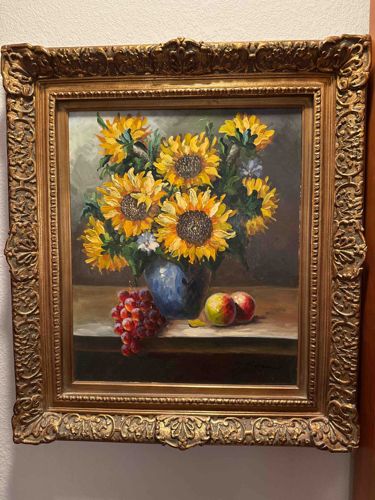
Still Life with Sunflowers and Fruit signed Kurigan

Fine Art - Painting

AI Estimated Value

·Not an official valuation·Verify before acting

$450 - $700

As of June 12, 2026

AI Item Analysis

·AI can make mistakes·Verify before acting
This is an original oil painting on canvas measuring 34x30 inches, featuring a vibrant floral still life composition. The central focus is a cluster of radiant sunflowers with thick, impasto-style yellow petals and dark, textured centers, arranged in a deep blue rounded ceramic vase. Scattered at the base of the vase on a tabletop surface are a bunch of red grapes and two small apples/pears, rendered with soft highlights. The background is a muted, neutral greyish-green, suggesting a late 20th-century impressionistic style. The artwork is signed 'Kurigan' in the lower right quadrant. The painting is housed in a substantial, ornate gilded wooden frame with high-relief scrollwork, shell motifs, and beaded trim, which adds approximately 4-6 inches to the overall dimensions. The frame's gold finish shows a slight antiqued patina with darker rubbing in the recessed areas. The canvas appears well-tensioned, though there are minor surface textures consistent with standard oil applications. The condition appears sound with no visible tears or significant paint loss, indicating good preservation. This piece represents a classic decorative mid-to-late 20th-century aesthetic, likely produced for the commercial art market where ornate framing was as much a feature as the subject matter itself.

AI Appraisal Report

·AI can make mistakes·Verify before acting
I have virtually examined this oil on canvas still life signed 'Kurigan.' The work is a decorative painting likely dating from the 1970s or 1980s. The artist utilized a heavy impasto technique in the sunflowers to create 'pop' and visual interest, a style frequently sold through high-end furniture showrooms or commercial galleries during the late 20th century. My visual inspection indicates the canvas is well-preserved with no signs of craquelure or humidity damage, and the ornate gilded frame is in excellent condition, significantly contributing to the item's overall marketability. Market demand for large-scale, floral still-lifes remains steady for traditional interior design, though 'Kurigan' is not a high-profile auction artist; this piece is valued primarily as a decorative asset rather than a fine art investment. Comparable sales for similar oversized mid-century floral works with premium framing typically fall in the mid-hundreds range at estate auctions. Important Limitations: As this is a visual inspection of digital media, I cannot confirm the exact chemical composition of the pigments or the presence of an underdrawing. A full authentication would require physical inspection under UV light to check for overpainting or repairs. To move beyond a Fair Market Value for decorative purposes to a definitive fine art attribution, documented provenance—such as a gallery receipt from the original purchase or inclusion in a recorded artist catalog—would be necessary. The signature appears consistent with the period, but without physical examination of the canvas weave and stretcher bars, the distinction between a mass-produced commercial studio piece and a singular artist commission cannot be fully determined.

Get your items appraised

Instant estimates of your treasures with AI-powered appraisals

Browse More Appraisals