AI estimate as of October 24, 2025 · verify with a professional before acting
AI-Generated · Verify before acting
Everything on this page is generated by AI for informational purposes only. AI can make mistakes — the AI may misidentify items or misattribute them (artist, maker, brand, designer, origin, era). This is not an official valuation and should not be used for insurance, sale, tax, estate, legal, or lending purposes — or any decision requiring a certified appraisal. It is not an authoritative claim about any person, brand, or rights holder — do not share or rely on it as a factual statement about a third party. Always consult qualified professionals before making financial decisions.
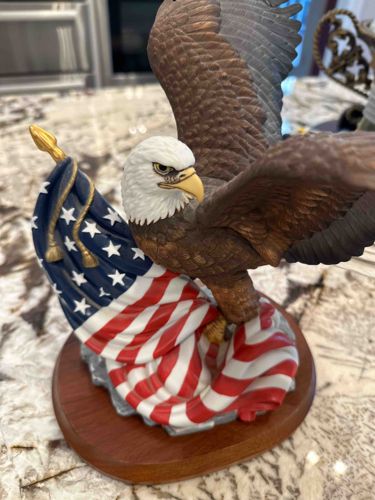
This item is a decorative figurine depicting a majestic bald eagle alongside a draped American flag, mounted on a wooden base. The eagle is captured in a dynamic pose, seemingly in mid-flight or about to land, with its wings partially spread. Its plumage is intricately detailed, showcasing shades of dark brown on the body and wings, contrasting with the iconic white head and tail feathers. The beak is a distinct yellow-orange, and the eyes are sharply rendered. The American flag is depicted with flowing folds, displaying the traditional red and white stripes and a blue canton with white stars, though the precise number of stars is not fully visible. A golden finial or flagpole top is visible at the upper left of the flag. The entire sculpture rests on what appears to be a light brown, possibly mahogany or stained wood, oval-shaped base. The materials used seem to be resin or a similar composite material for the eagle and flag, carefully hand-painted to achieve realistic textures and colors. The craftsmanship suggests a focus on patriotic themes and wildlife art. There are no immediate visible condition issues such as chips, cracks, or repairs, and the paint finish appears well-preserved, indicating good care or relatively recent production. The detail in the feathers and fabric texture suggests a moderate to high level of quality in its manufacture. The style is representational, likely from the late 20th or early 21st century.
AI Appraisal Report
Based on my visual examination of the provided image, this decorative figurine, featuring a bald eagle and an American flag on a wooden base, appears to be in excellent condition. There are no immediate visible signs of chips, cracks, or repairs, and the paint finish seems well-preserved. The intricate detailing of the eagle's plumage and the flowing folds of the flag suggest a moderate to high level of quality in its manufacture, likely crafted from resin or a similar composite and hand-painted. The style is representational, consistent with pieces produced in the late 20th or early 21st century focusing on patriotic and wildlife themes.
Market conditions for such patriotic-themed decorative figurines are generally stable, but the upper end of demand is primarily for pieces with artist signatures, limited editions, or from renowned manufacturers. This piece, while aesthetically pleasing and well-executed, does not immediately present indicators of being a high-end collectible without further information. Comparables in the retail market, from online sellers to gift shops, typically range from $30 to $100 depending on size, brand, and perceived quality. Without a visible maker's mark or artist's signature, it is hard to differentiate it from similar mass-produced items.
The main factors impacting its value are its good condition and the popular, enduring patriotic theme. However, its likely lack of rarity and absence of identifiable provenance or a known artist limit its potential for higher valuation. While the craftsmanship is good, it is not uniquely exceptional to command a premium.
Without an in-person examination, I cannot definitively confirm the material composition beyond what appears to be resin. I also cannot verify the presence or absence of any maker's marks, artist signatures, or limited edition numbers that might be hidden or not visible in the image. Furthermore, without provenance documentation, authenticity in terms of a specific artist or manufacturer cannot be fully established. A physical inspection would allow for tactile assessment of materials, a thorough search for identifying marks, and an evaluation of weight and finish quality that is impossible from images alone.