AI estimate as of June 21, 2025 · verify with a professional before acting
AI-Generated · Verify before acting
Everything on this page is generated by AI for informational purposes only. AI can make mistakes — the AI may misidentify items or misattribute them (artist, maker, brand, designer, origin, era). This is not an official valuation and should not be used for insurance, sale, tax, estate, legal, or lending purposes — or any decision requiring a certified appraisal. It is not an authoritative claim about any person, brand, or rights holder — do not share or rely on it as a factual statement about a third party. Always consult qualified professionals before making financial decisions.
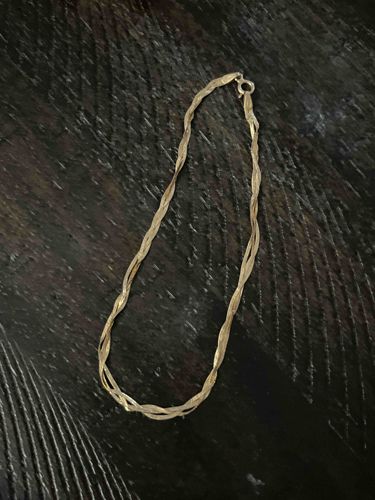
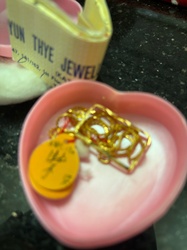
This item is a necklace, appearing to be crafted from a metallic material that exhibits a brassy or antique gold tone, resting on a dark, possibly wood, surface. The necklace is composed of multiple strands, specifically four, which are interwoven or twisted together to create a cohesive, braided design. Each individual strand is relatively thin, presenting a flat or ribbon-like profile rather than a round one, contributing to the overall fluid appearance of the piece. The twisting of the strands creates a subtle helical pattern along the length of the necklace. At one end, a small, circular clasp is visible, typical of a spring ring or similar closure mechanism. The metal shows some evidence of wear or patina, suggesting it is not newly manufactured and may have been worn previously. There are no immediate signs of severe damage such as breaks or significant kinking, but the overall luster appears somewhat muted, indicative of age or common surface wear. The craftsmanship appears to be commercially produced, with no obvious unique artisan marks discernible from the image. Its style suggests it could be from the mid-to-late 20th century, a period when multi-strand and braided designs were popular. The quality seems decent for costume jewelry or a fashion accessory, given the visible construction and material. Without closer inspection, the exact metal content (e.g., gold-plated, brass, or another alloy) cannot be definitively determined, but its color leans towards a warm, yellowish hue.
AI Appraisal Report
I have examined the Multi-Strand Braided Chain Necklace via the provided image. This piece is a four-strand braided necklace, exhibiting a brassy or antique gold tone, consistent with costume jewelry materials such as gold-plated brass or a similar alloy. The individual strands are flat/ribbon-like, creating a subtle helical pattern. A circular spring ring clasp is visible, suggesting standard commercial production. The overall condition appears fair to good for its age, showing some surface wear and patination, which mutes its luster. There are no overt signs of significant damage like breaks or severe kinking. Authenticity, based solely on visual inspection, points towards a commercially produced fashion accessory, likely from the mid-to-late 20th century, a period when such braided designs were common. Market conditions for costume jewelry are highly dependent on material quality, designer attribution, and overall condition. Without any designer marks, and given its common style and visible wear, its value is primarily decorative. Comparable items of similar age and material, without precious metal content or designer provenance, typically retail in the lower price range within the costume jewelry market. Demand for generic vintage costume jewelry is moderate; rarity is low as similar pieces were mass-produced. Factors significantly impacting value include the non-precious metal composition, the visible wear, and the lack of a known maker. Limitations in authenticity verification from an image alone are considerable. I cannot definitively determine the metal content (e.g., gold plating vs. solid brass), nor can I inspect for hidden marks or repairs. An in-person examination would allow for tactile assessment, precise measurement, close inspection for hallmarks or maker's marks, and potentially a jewelers' loupe examination to assess surface integrity and plating thickness. Material testing (e.g., XRF analysis) would be crucial for definitive metal identification. Provenance documentation, though unlikely for this type of item, would also add value.