AI estimate as of November 16, 2025 · verify with a professional before acting
AI-Generated · Verify before acting
Everything on this page is generated by AI for informational purposes only. AI can make mistakes — the AI may misidentify items or misattribute them (artist, maker, brand, designer, origin, era). This is not an official valuation and should not be used for insurance, sale, tax, estate, legal, or lending purposes — or any decision requiring a certified appraisal. It is not an authoritative claim about any person, brand, or rights holder — do not share or rely on it as a factual statement about a third party. Always consult qualified professionals before making financial decisions.
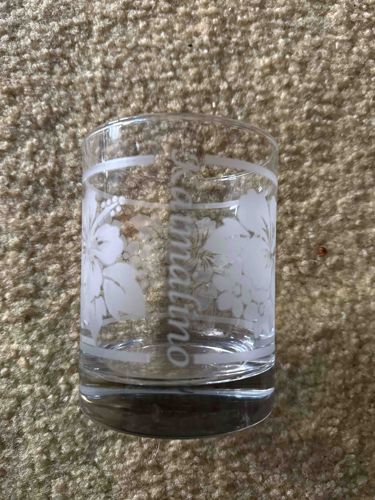
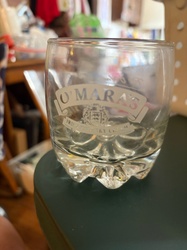
This item is a clear glass tumbler, likely a rocks glass or an old-fashioned glass, characterized by its cylindrical form and thick base. The glass itself appears to be of standard commercial quality, perfectly transparent and free of visible color tinting. The most prominent feature is the frosted, acid-etched or sandblasted decoration encircling the upper two-thirds of the glass. This decoration consists of an intricate floral and grape vine motif, featuring detailed leaves, clusters of grapes, and blooming flowers, which suggests a possible connection to viticulture or a general aesthetic appreciation for natural botanicals. Embedded within this continuous pattern, running vertically or diagonally across one side of the glass, is a cursive script word, which appears to read 'Palatino' or 'Valentino,' though the exact lettering is slightly obscured due to the angle and limited view. The top and bottom edges of the etched design are bordered by thin, frosted lines, providing a neat finish. The glass has a thick, heavy base, common in tumblers designed for stability and durability, and to provide thermal insulation for chilled drinks. No visible chips, cracks, or significant scuffing are apparent from the image, suggesting it is in good, used condition. There are no obvious maker's marks or signatures visible on the exterior; however, such marks are often found on the very bottom of the base, which is not depicted. The style of the etching suggests an aesthetic popular from the mid-20th century to contemporary times, possibly indicating a promotional item or a piece from a commercially available glassware set. The craftsmanship of the etching appears even and well-defined.
AI Appraisal Report
I have virtually examined this Etched Glass Tumbler with Floral and Grape Motif. From the provided image, the tumbler appears to be in good, used condition, free of visible chips, cracks, or significant scuffing. The etching is consistent and well-defined, suggesting quality craftsmanship for its type. The design, featuring floral and grape motifs along with a script word (possibly 'Palatino' or 'Valentino'), is aesthetically pleasing but not unique enough to indicate a rare or highly collectible piece. Without further context, the script suggests it could be a promotional item, a commemorative piece, or part of a commercially available set. These types of etched tumblers were popular throughout the mid-20th century to contemporary times. Market conditions for common etched glassware are generally stable but do not command high prices unless associated with a significant maker, designer, or historical event. Comparable items, even with intricate designs, typically retail in the lower price range if sold individually at antique shops, online marketplaces, or second-hand stores. Demand for such a piece is moderate, primarily from collectors of vintage glassware or individuals seeking replacement pieces for a set. Rarity is low, as similar items were mass-produced. Factors significantly impacting value would be positive identification of a notable manufacturer, a complete set, or confirmed historical significance related to the inscribed word. Without a physical inspection, authenticating its exact age or manufacturer is impossible. An in-person examination would allow for inspection of the base for maker's marks, assessment of the glass's quality beyond surface appearance, and a definitive reading of the script. Provenance documentation would be crucial for establishing any significant historical context or designer attribution, which is currently lacking.