AI estimate as of July 26, 2025 · verify with a professional before acting
AI-Generated · Verify before acting
Everything on this page is generated by AI for informational purposes only. AI can make mistakes — the AI may misidentify items or misattribute them (artist, maker, brand, designer, origin, era). This is not an official valuation and should not be used for insurance, sale, tax, estate, legal, or lending purposes — or any decision requiring a certified appraisal. It is not an authoritative claim about any person, brand, or rights holder — do not share or rely on it as a factual statement about a third party. Always consult qualified professionals before making financial decisions.
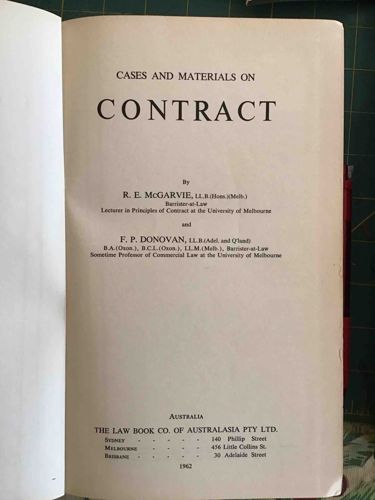
This item is an academic legal textbook titled "Cases and Materials on Contract." The title page, which is the primary subject of the image, is made of off-white or cream-colored paper, suggesting some age or less bleached pulp than modern paper. The text is printed in black ink, with the main title "CONTRACT" prominently displayed in a large, bold, sans-serif font, while "CASES AND MATERIALS ON" is in a smaller, standard serif font above it. Below the title, the authors are listed: R. E. MCGARVIE, LL.B(Hons)(Melb), Barrister-at-Law and Lecturer in Principles of Contract at the University of Melbourne; and F. P. DONOVAN, LL.B(Adel and Q'land), B.A.(Oxon.), B.C.L.(Oxon.), LL.M.(Melb.), Barrister-at-Law and Sometime Professor of Commercial Law at the University of Melbourne. The publisher is identified as THE LAW BOOK CO. OF AUSTRALASIA PTY LTD., located in Australia, with addresses provided for Sydney (140 Phillip Street), Melbourne (456 Little Collins St.), and Brisbane (30 Adelaide Street). The publication year, clearly visible at the bottom of the page, is 1962.
The page exhibits signs of age and handling, including a slight yellowing or tanning of the paper, consistent with older books. There are no significant tears, creases, or major stains visible on this particular page, indicating a relatively well-preserved condition for its age. The edges appear somewhat soft from use, and the bottom right corner shows a minor dog-ear or slight bend. The binding is not visible, but the left edge shows the book's gutter, suggesting it is a traditionally bound volume. The print quality appears clear and legible, with no apparent smudging or fading. The overall aesthetic is functional and academic, typical of legal texts from the mid-20th century. The specific content of 'cases and materials' indicates it is likely a book used for studying legal precedents and academic discourse in contract law.
AI Appraisal Report
Upon examining the provided image of 'Cases and Materials on Contract' by McGarvie and Donovan (1962), my assessment is that the book is in good condition for its age. The paper exhibits expected yellowing and the subtle dog-ear on the bottom right corner indicates typical handling, yet there are no significant tears or major stains visible on the title page, suggesting it has been reasonably well-preserved. Authenticity, based solely on the image, appears strong given the clear publication details matching known historical records for legal texts of this period.
In terms of market conditions, academic legal textbooks from the mid-20th century typically do not command high prices unless they represent unique first editions, significant historical legal commentary, or are signed by notable figures. This particular volume, while a cornerstone text for its time, likely holds more sentimental or academic value than significant monetary worth. Demand for such specific, dated legal academic works is generally low, limited primarily to specialized collectors of legal history or institutions seeking to complete archives. It's not rare in the sense of being one of a few copies, though good condition copies might be less common.
The primary factor impacting value negatively is its specialized academic nature and age, which makes its legal content largely superseded by newer editions and evolving legal precedent.
Limitations in authenticity verification from images alone include the inability to inspect the full binding, paper quality beyond the title page (e.g., foxing internally, brittleness), or to confirm whether all pages are present. A full physical examination would allow for tactile assessment of paper integrity, verification of the complete paginaton, a detailed condition report on the entire book (including boards and spine), and assessment for any hidden damage or repairs. Provenance documentation, such as prior ownership records, could further enhance its appeal to collectors, but is not typically a major value driver for this type of item.