AI Appraisal Estimate

AI-generated estimates · not official valuations

From the user

What was submitted

Photo and notes provided by the user — not generated by AI

Submitted item photo
Submitted photo · June 4, 2026

User's notes

No additional notes provided.

AI analysis below

AI appraisal

AI analysis & estimate

AI-Generated · Verify before acting

Everything below is generated by AI for informational purposes only. AI can make mistakes — the AI may misidentify items or misattribute them (artist, maker, brand, designer, origin, era). This is not an official valuation and should not be used for insurance, sale, tax, estate, legal, or lending purposes — or any decision requiring a certified appraisal. It is not an authoritative claim about any person, brand, or rights holder — do not share or rely on it as a factual statement about a third party. Always consult qualified professionals before making financial decisions.

Read the full disclaimer

AI Identification

·Not independently authenticated·Verify before acting

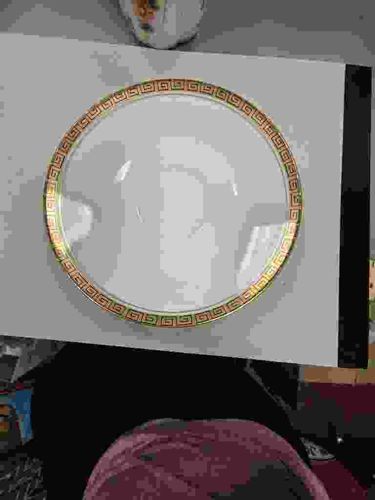
Greek Key Porcelain Dinner Plate

Antique & Vintage Ceramic Tableware

AI Estimated Value

·Not an official valuation·Verify before acting

$45 - $85

As of June 4, 2026

AI Item Analysis

·AI can make mistakes·Verify before acting
This is a circular dinner plate constructed of white porcelain or fine bone china, featuring a prominent decorative border. The primary aesthetic feature is a continuous Greek Key (Meander) decorative band in a rusty-red or terracotta tone, flanked by thin gold-toned or yellow concentric rings that provide a gilded metallic appearance. The center of the plate is left plain white with a glossy glaze, which is highly reflective as evidenced by the light highlights on the surface. In terms of construction, the plate appears to have a standard shallow well and a wide rim, characteristic of formal dinnerware. While no maker's mark is visible from the top view, the precision of the geometric Greek Key pattern suggests a mid-to-late 20th-century production, possibly inspired by Neo-Classical revivals or luxury fashion house housewares (such as Versace or similar decorative styles). The condition appears to be excellent with no visible chips, cracks, or significant crazing, though there may be minor shelf wear on the underside not visible here. The gold gilding on the edges appears intact without the typical rubbing associated with heavy use or frequent machine washing, suggesting it may have been used primarily for display or special occasions.
AI Appraisal Report

·AI can make mistakes·Verify before acting
Based on my visual examination of the Greek Key Porcelain Dinner Plate, I have assessed the item as a modern high-quality tableware piece, likely manufactured in the late 20th century. The plate features a classic Meander pattern in a terracotta hue, complemented by gold-toned banding. The high-gloss glaze and precision of the lithographed transferware suggest a production process consistent with luxury manufacturers, though without a visible backstamp, a definitive attribution to a house like Versace or Rosenthal cannot be confirmed. The condition appears near-mint, with no evidence of gilding loss or surface scratching, indicating minimal utility use. The market for single replacement dinner plates is currently stable, driven primarily by collectors looking to complete sets or individuals using them as decorative wall pieces. Comparables for unsigned high-end Greek Key porcelain typically sell in the $40–$60 range, whereas authenticated designer pieces can fetch $150 or more. Because I cannot see the underside, this valuation assumes a high-quality unmarked or mid-tier manufacturer. Factors such as the 'Neo-Classical' appeal sustain demand, though the lack of a complete set limits the immediate investment potential. Limitations: This appraisal is based solely on photographic evidence. A physical inspection is required to determine the material (bone china vs. hard-paste porcelain) and to verify if the gold banding is 24k gold leaf or a metallic pigment. For a conclusive authentication, a clear image of the maker's mark and provenance regarding the original purchase would be necessary. To rule out contemporary mass-market reproductions, I would need to examine the foot rim for 'shelf wear' and tactile irregularities.

Get your items appraised

Instant estimates of your treasures with AI-powered appraisals

Browse More Appraisals