AI estimate as of December 4, 2025 · verify with a professional before acting
AI-Generated · Verify before acting
Everything on this page is generated by AI for informational purposes only. AI can make mistakes — the AI may misidentify items or misattribute them (artist, maker, brand, designer, origin, era). This is not an official valuation and should not be used for insurance, sale, tax, estate, legal, or lending purposes — or any decision requiring a certified appraisal. It is not an authoritative claim about any person, brand, or rights holder — do not share or rely on it as a factual statement about a third party. Always consult qualified professionals before making financial decisions.
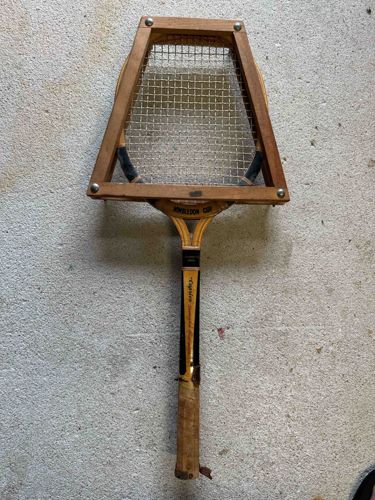
The item depicted is a vintage badminton racquet press constructed predominantly of wood. It features a trapezoidal or roughly 'A'-frame shape, designed to clamp around the head of a badminton racquet to maintain the frame's integrity and prevent warping when not in use. The main frame components are made of light-to-medium toned wood, likely a hardwood such as ash or maple, given its intended function of providing structural support. The visible surfaces of the wood exhibit a natural grain, with some areas showing a slightly darker patina indicative of age and handling. The joinery appears to be either doweled or mortise-and-tenon, reinforced at the four corners by prominent flat-head metal screws or rivets with a silver or nickel finish. The central part of the press is fitted with a dense, fine-gauge metal mesh, possibly galvanized steel or another durable alloy, which would rest directly against the racquet strings. This mesh is securely fastened within the wooden frame. At the base of the 'A' frame, there are two small, dark, possibly leather or rubber pads, which would provide cushioning against the racquet shoulders. The neck of a racquet, partially visible beneath the press, is dark-stained wood with a contrasting lighter strip, likely indicating the original racquet frame material. A visible label or stencil on the racquet neck reads 'JOHNSON CORP' and 'KROYDON.' The grip of the racquet, extending downwards, is wrapped in a light-colored, aged material, possibly leather or a textile, showing significant wear, discoloration, and fraying, with a small piece of the wrapping detaching near the butt end. The overall condition suggests considerable age and use, with expected wear and tear, but the press itself appears structurally sound. This item would likely date from the mid-20th century, possibly 1930s-1960s, a period when wooden racquets and their accompanying presses were common.
AI Appraisal Report
Based on my visual examination of the provided image, this vintage badminton racquet press is in good, structurally sound condition for its age. The wood components appear robust, with expected patina and minor cosmetic wear, indicating careful use and storage over time. The metal mesh is intact, and the fastening mechanisms seem secure. The presence of 'JOHNSON CORP' and 'KROYDON' on the accompanying racquet neck, though not part of the press itself, helps to contextualize the era, likely mid-20th century (1930s-1960s). Authenticity of the press itself is high given its construction and design consistent with the period; these items were utilitarian and widely produced.
Market conditions for vintage sporting goods accessories like racquet presses are generally niche. While there's a steady demand from collectors of vintage sports equipment, enthusiasts of historical tennis/badminton, or those seeking decorative items, these presses are not exceedingly rare. Many were produced, and while finding one in excellent condition is a plus, it doesn't significantly elevate its value into a high-tier collectible category.
The primary factors affecting value are its good structural integrity and clear vintage appeal. The visible wear on the racquet grip, while adding to the item's story, does not directly impact the press's value.
It is important to note that this assessment is based solely on visual cues from an image. For full authentication and a more precise value, an in-person examination would be beneficial to assess details like wood type, joinery quality, specific material of the mesh, and the exact condition of the small leather/rubber pads. Physical inspection would also confirm the absence of hidden cracks, repairs, or woodworm damage. Provenance documentation, though unlikely for such an item, could add marginal value if linked to a significant historical figure or event. Scientific testing is generally not applicable or necessary for an item of this type.