These notes were written by the person who submitted this item. Appraiser.AI has not verified them, and the AI's identification and estimate may rely on them.
AI Estimated Value
Not an official valuation
$150 - $350
AI estimate as of August 2, 2025 · verify with a professional before acting
AI-Generated · Verify before acting
Everything on this page is generated by AI for informational purposes only. AI can make mistakes — the AI may misidentify items or misattribute them (artist, maker, brand, designer, origin, era). This is not an official valuation and should not be used for insurance, sale, tax, estate, legal, or lending purposes — or any decision requiring a certified appraisal. It is not an authoritative claim about any person, brand, or rights holder — do not share or rely on it as a factual statement about a third party. Always consult qualified professionals before making financial decisions.
This analysis also relies on unverified notes provided by the user, which may be incomplete or inaccurate and could affect the result.
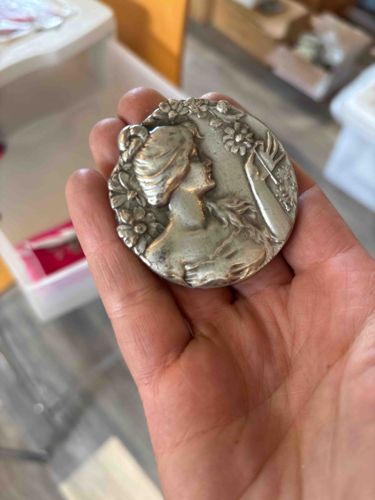
This appears to be an antique or vintage belt buckle, likely made of white metal such as pewter, Britannia metal, or possibly silver-plated brass, given its color and the level of detail. The buckle is oval or slightly irregular in shape and features a highly detailed repoussé or cast design characteristic of the Art Nouveau period, estimated between the late 19th century and early 20th century (circa 1890-1910). The central motif depicts the profile of a woman's head and upper torso, possibly a nymph or a classical figure, facing right. Her hair is rendered with flowing lines and appears to be adorned with or intertwined with floral elements. The background is replete with naturalistic details, specifically an abundance of flowers and foliage, which are hallmarks of the Art Nouveau aesthetic, emphasizing organic forms. To the right of the woman's head, there is a distinct, elongated object that seems to be a stylized bird, possibly a swan, or another abstract natural form common in the period's decor. The overall relief of the design is moderate to high, indicating good craftsmanship, with clear delineation of features. The surface shows a dull, aged patina, consistent with the age of the piece, suggesting it has not been heavily polished, which is desirable for preserving its antique character. There is visible wear on the raised areas, such as the woman's cheek and the outer edges, indicating decades of use or handling. No specific maker's marks or signatures are discernible from the provided image, but such pieces often have marks on the reverse side. The item's physical size is such that it fits comfortably within the palm of a hand, suggesting it is a standard size for a ladies' belt buckle of the era. The construction appears solid, with no clear signs of damage beyond surface wear and aging. The quality of the casting or repoussé work is evident in the intricate details of the hair and flowers, reflecting a skilled artisan's touch.
AI Appraisal Report
Upon examining the provided images of this Art Nouveau style belt buckle, I can confirm it is a fine example of the period, likely dating from circa 1890-1910. The design, featuring a female profile with flowing hair intertwined with floral and faunal motifs, is highly characteristic of the Art Nouveau movement's emphasis on natural, organic forms. The piece appears to be made of a white metal, possibly silver-plated brass, pewter, or Britannia metal, consistent with materials used for such accessories during that era. The repoussé or cast work displays a high level of craftsmanship in its detailed rendering.
The condition appears to be good for its age, exhibiting an attractive, undisturbed patina and expected surface wear on the high points. This indicates a history of use but no significant damage. The market for authentic Art Nouveau decorative arts and jewelry remains strong, with collectors particularly drawn to well-executed, iconic designs like this one. Comparable silver-plated or pewter buckles of similar quality and intricacy typically sell in the range of $150 to $350 at auction or through specialized dealers. The absence of a visible maker's mark (such as WMF, Unger Bros., or a French silversmith) prevents a higher valuation, as signed pieces command a premium.
It is crucial to note the limitations of an appraisal based solely on images. A definitive assessment of authenticity and material composition requires physical examination. In-person, I would test the metal for silver content, examine the reverse for any maker's marks or hallmarks, and assess the construction method (cast vs. stamped/repoussé) more closely. Without this hands-on inspection, the stated value represents a fair market value based on the visible characteristics alone.