AI Appraisal Estimate

AI-generated estimates · not official valuations

From the user

What was submitted

Photo and notes provided by the user — not generated by AI

Submitted item photo
Submitted photo · June 8, 2026

User's notes

Unknown artist, unknown sculpture

AI analysis below

AI appraisal

AI analysis & estimate

AI-Generated · Verify before acting

Everything below is generated by AI for informational purposes only. AI can make mistakes — the AI may misidentify items or misattribute them (artist, maker, brand, designer, origin, era). This is not an official valuation and should not be used for insurance, sale, tax, estate, legal, or lending purposes — or any decision requiring a certified appraisal. It is not an authoritative claim about any person, brand, or rights holder — do not share or rely on it as a factual statement about a third party. Always consult qualified professionals before making financial decisions.

Note

This analysis also relies on unverified notes provided by the user, which may be incomplete or inaccurate and could affect the result.

Read the full disclaimer

AI Identification

·Not independently authenticated·Verify before acting

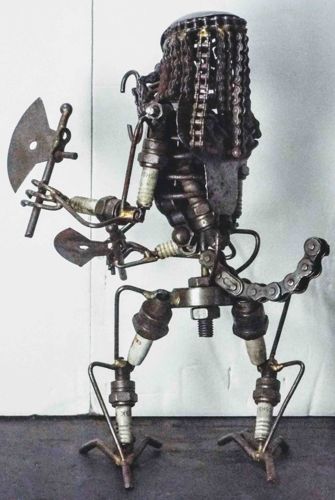
Recycled Metal Predator Sculpture

Folk Art / Metal Sculpture

AI Estimated Value

·Not an official valuation·Verify before acting

$150 - $250

As of June 8, 2026

AI Item Analysis

·AI can make mistakes·Verify before acting
This is a handmade figurative sculpture of the iconic 'Predator' character, meticulously assembled from repurposed mechanical scrap metal and automotive parts. The piece stands approximately 10 to 14 inches tall, though exact dimensions are unverified. It features a head constructed with hanging lengths of bicycle or motorcycle chain to represent the character's signature dreadlocks, and a body core utilizing a thick coil spring for the torso. Its limbs and joints are cleverly formed from automotive spark plugs, particularly evident in the upper arms and lower legs, which retain their white ceramic insulators. The hands and claw-like feet are fashioned from welded metal rods and bent wire. The figure is depicted in a dynamic stance, holding a poleaxe or halberd-style weapon crafted from a flat metal blade and rod. A curved mechanical chain serves as a tail or dorsal extension. The metal displays a dark, aged patina with significant oxidation and surface rust, particularly on the axe blade and chain links, suggesting a raw 'industrial' or 'steampunk' aesthetic. There are visible weld marks where components are joined, indicating manual craftsmanship. While no maker's mark is visible, this style of folk art is common in the late 20th and early 21st centuries, often found in artisan markets. The condition is consistent with 'found object' art, where existing wear on the mechanical parts contributes to the overall character of the piece.
AI Appraisal Report

·AI can make mistakes·Verify before acting
Upon my visual inspection of this metalwork sculpture, I find it to be a quintessential example of 'Scrap Metal Folk Art' or 'Upcycled Art,' specifically drawing from sci-fi pop culture iconography. The piece demonstrates clever creative engineering, utilizing recognizable components such as spark plugs for limbs, a heavy coil spring for the torso, and motorcycle chains for the iconic dreadlocks. The condition is consistent with the medium; the surface oxidation and rust appear to be intentional or aged naturally through exposure, characteristic of the 'industrial' aesthetic. Market conditions for this type of work are relatively stable but limited by the fact that these are often mass-produced in artisan workshops across Southeast Asia and Mexico. While unique in its hand-welded assembly, the lack of a recognizable maker’s mark or signature places it in the category of decorative souvenir or common market craft rather than 'fine art.' The Predator character remains highly collectible, which helps maintain a baseline demand, but the market is saturated with similar scrap-metal iterations varying in height from 10 to 36 inches. From these images alone, authenticity as a unique 'artist piece' cannot be verified. I cannot determine the structural integrity of the welds or whether the patina is artificially induced with chemicals. A physical examination would be required to check for hidden signatures or stamps and to assess the weight and quality of the joining. To fully authenticate this as a high-value collectible, provenance documentation (such as a gallery receipt or artist certificate) would be necessary. Without such evidence, the value is based on its decorative appeal and scrap-metal craftsmanship.

Get your items appraised

Instant estimates of your treasures with AI-powered appraisals

Browse More Appraisals