These notes were written by the person who submitted this item. Appraiser.AI has not verified them, and the AI's identification and estimate may rely on them.
AI Estimated Value
Not an official valuation
$2,500 - $4,500
AI estimate as of November 5, 2025 · verify with a professional before acting
AI-Generated · Verify before acting
Everything on this page is generated by AI for informational purposes only. AI can make mistakes — the AI may misidentify items or misattribute them (artist, maker, brand, designer, origin, era). This is not an official valuation and should not be used for insurance, sale, tax, estate, legal, or lending purposes — or any decision requiring a certified appraisal. It is not an authoritative claim about any person, brand, or rights holder — do not share or rely on it as a factual statement about a third party. Always consult qualified professionals before making financial decisions.
This analysis also relies on unverified notes provided by the user, which may be incomplete or inaccurate and could affect the result.
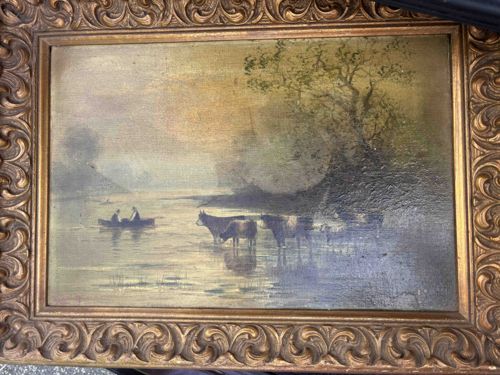
This is a late 19th-century oil painting on canvas, likely depicting a pastoral landscape scene. The painting features a serene body of water, possibly a river or lake, where three cows are partially submerged, grazing or drinking. To the left, two figures are visible in a small rowboat or canoe, adding a human element to the natural setting. The background shows a hazy or misty atmosphere, with indistinct hills or mountains in the distance and a large, verdant tree prominent on the right bank. The color palette primarily consists of muted greens, browns, and blues, with a warm, soft glow emanating from the central sky, suggesting either dawn or dusk. The paint application appears to be somewhat thick in areas, particularly in the foliage, indicating visible brushstrokes. The canvas texture is visible through the paint layers in certain lighter areas. The painting is housed within a substantial, ornate gilded frame. The frame features intricate rococo-style scrolling and swirling relief patterns, characteristic of frames from the late 19th or early 20th century. The gold gilt finish shows signs of wear and age, with some areas of rubbing and possible darkening of the finish, contributing to its antique appearance. There are no clear visible artist signatures or marks from the provided images. The overall condition of the painting appears consistent with its estimated age; there may be some craquelure, subtle discoloration due to varnish aging, and surface dirt, which are common for artworks of this period. The style suggests an influence of Romanticism or Tonalism due to its atmospheric quality and focus on nature's mood. Given the '1899 martini j oil painting' context, it can be confidently dated to 1899, possibly by an artist with the initial 'J Martini'.
AI Appraisal Report
Based on my visual examination of the provided image, this late 19th-century oil painting, dated 1899 and potentially by 'J. Martini', presents as a charming pastoral landscape. The condition appears consistent with its age, showing expected craquelure, subtle discoloration from aged varnish, and surface dirt. The visible brushstrokes and canvas texture are typical of the period. Authenticity is supported by the 1899 date provided. The ornate, gilded rococo-style frame complements the artwork well and adds to its antique appeal despite signs of wear. Market conditions for un-attributed or lesser-known late 19th-century landscape artists can be variable. While the quality of execution appears good, the lack of a prominent artist signature limits its value to a degree, placing it more in the decorative arts market rather than that of highly collectible masters. Comparables would include similar atmospheric landscape paintings from the period by regional or unlisted artists, often fetching prices in this range, particularly with attractive framing. Demand for decorative period pieces remains steady. The rarity is moderate; while a specific artist named 'J. Martini' from 1899 is not immediately recognizable as a major figure, the piece stands on its aesthetic merits. A key factor impacting value is the lack of a known, collectable artist. For full authentication and to ascertain the artist's full name, an in-person examination would be crucial to inspect for hidden signatures, a condition report, archival research into 'J. Martini', and potentially scientific analysis of paint pigments. Provenance documentation, if available, would provide significant value enhancement.