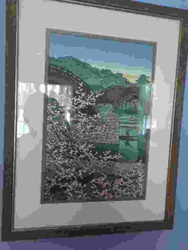
Japanese Ukiyo-e Woodblock Print with Signature and Censor Seals
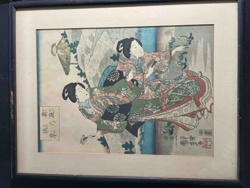
This is a detailed close-up of a Japanese ukiyo-e woodblock print, demonstrating characteristic artistic markings of the Edo or Meiji period. The piece features a dark, likely black, background with a series of distinct cartouches and seals. On the left is a red vertical rectangular cartouche containing the artist's signature in black ink, which appears to be Hiroshige (likely Utagawa Hiroshige II or III based on the seal arrangement). Next to it are two circular 'nanushi' censor seals, which were used to approve prints for publication, typically dating the piece between 1843 and 1853. Below these, a white square publisher's seal provides further identification of the manufacturing origin. The color palette includes deep reds, jet blacks, and hints of ochre or orange in the architectural element at the top. The print shows evidence of age with visible paper foxing and some surface abrasion or damage noted at the top corner of the red cartouche. The craftsmanship is evidenced by the precision of the block-cutting for the fine characters within the seals and the saturated application of natural pigments. The overall style suggests a landscape or 'bird-and-flower' series from the mid-19th century.
AI-Generated Appraisal Disclaimer
Estimated Value
$400-$700
Basic Information
Category
Antique Japanese Fine Art
Appraised On
April 21, 2026
Estimated Value
$400-$700
Item Description
This is a detailed close-up of a Japanese ukiyo-e woodblock print, demonstrating characteristic artistic markings of the Edo or Meiji period. The piece features a dark, likely black, background with a series of distinct cartouches and seals. On the left is a red vertical rectangular cartouche containing the artist's signature in black ink, which appears to be Hiroshige (likely Utagawa Hiroshige II or III based on the seal arrangement). Next to it are two circular 'nanushi' censor seals, which were used to approve prints for publication, typically dating the piece between 1843 and 1853. Below these, a white square publisher's seal provides further identification of the manufacturing origin. The color palette includes deep reds, jet blacks, and hints of ochre or orange in the architectural element at the top. The print shows evidence of age with visible paper foxing and some surface abrasion or damage noted at the top corner of the red cartouche. The craftsmanship is evidenced by the precision of the block-cutting for the fine characters within the seals and the saturated application of natural pigments. The overall style suggests a landscape or 'bird-and-flower' series from the mid-19th century.

Get Your Items Appraised
Instant estimates of your treasures with AI-powered instant appraisals