AI estimate as of August 8, 2025 · verify with a professional before acting
AI-Generated · Verify before acting
Everything on this page is generated by AI for informational purposes only. AI can make mistakes — the AI may misidentify items or misattribute them (artist, maker, brand, designer, origin, era). This is not an official valuation and should not be used for insurance, sale, tax, estate, legal, or lending purposes — or any decision requiring a certified appraisal. It is not an authoritative claim about any person, brand, or rights holder — do not share or rely on it as a factual statement about a third party. Always consult qualified professionals before making financial decisions.
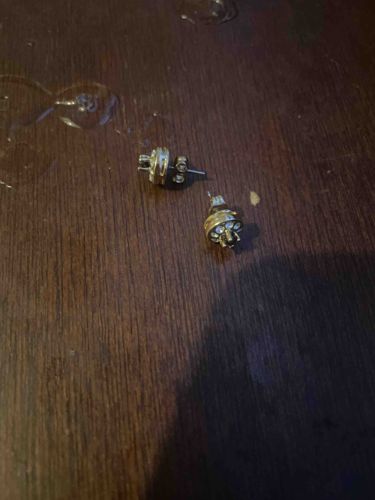
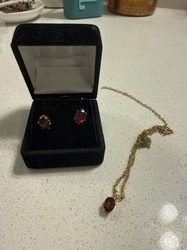
This item is a pair of stud earrings, characterized by their small, circular design. Each earring appears to be constructed from a metallic material, likely a base metal with a brassy or gold-toned finish, exhibiting some patina or wear that suggests age or frequent use. The posts are clearly visible, indicating they are designed for pierced ears. The front face of each earring features a cluster of small, clear, faceted stones, possibly cubic zirconia or glass, set closely together to form a focal point. One earring is oriented to show its backing, which appears to be a standard butterfly clutch or push-back style, although the precise mechanism is not perfectly clear due to the angle and focus. The overall craftsmanship seems to be of a mass-produced quality, common in costume jewelry. There are no discernible maker's marks or signatures visible in the provided image. The approximate age is difficult to determine without additional context, but they appear to be contemporary or from the late 20th to early 21st century. The metallic finish shows some discoloration, which could be tarnishing or rubbing off, indicating general wear consistent with used jewelry. Despite minor wear, the stones appear to be intact. The design is simple and classic, suggesting versatility for everyday wear or casual occasions. The size appears to be typical for stud earrings, likely less than 1 cm in diameter.
AI Appraisal Report
Upon visual examination of the provided image, I assess this pair of stud earrings to be costume jewelry. The condition exhibits signs of wear, including discoloration on the metallic-toned setting, consistent with common base metal or plated items. The stones, appearing to be clear, faceted clusters, are likely cubic zirconia or glass, typical of mass-produced pieces. There are no hallmarks or maker's marks visible, which further supports their classification as contemporary costume jewelry.
Market conditions for such items are generally low. Comparables would include similar new or used fashion jewelry available in department stores, online marketplaces, or second-hand shops. Demand for generic, unbranded costume jewelry is not high, and rarity is negligible, as similar designs are widely produced. Factors significantly impacting value here include the non-precious materials, lack of provenance, and visible wear. The primary value is decorative.
It is crucial to note the limitations of authenticity verification from images alone. Without physical inspection, I cannot confirm the exact composition of the metal (e.g., whether it's brass, copper, or a cheap alloy) or the precise nature of the stones (e.g., if they are indeed glass or a low-grade synthetic). An in-person examination would allow for closer inspection of the setting integrity, potential hidden marks, and qualitative testing of the materials. Provenance documentation would be necessary to establish any historical significance or a known manufacturer, which could potentially elevate value; however, none is provided. Scientific testing, such as spectroscopy for metal analysis or refractometry for stone identification, would be required for definitive authentication of material composition, but this is typically not cost-effective for items of this presumed low value.