These notes were written by the person who submitted this item. Appraiser.AI has not verified them, and the AI's identification and estimate may rely on them.
AI Estimated Value
Not an official valuation
$75 - $150
AI estimate as of July 31, 2025 · verify with a professional before acting
AI-Generated · Verify before acting
Everything on this page is generated by AI for informational purposes only. AI can make mistakes — the AI may misidentify items or misattribute them (artist, maker, brand, designer, origin, era). This is not an official valuation and should not be used for insurance, sale, tax, estate, legal, or lending purposes — or any decision requiring a certified appraisal. It is not an authoritative claim about any person, brand, or rights holder — do not share or rely on it as a factual statement about a third party. Always consult qualified professionals before making financial decisions.
This analysis also relies on unverified notes provided by the user, which may be incomplete or inaccurate and could affect the result.
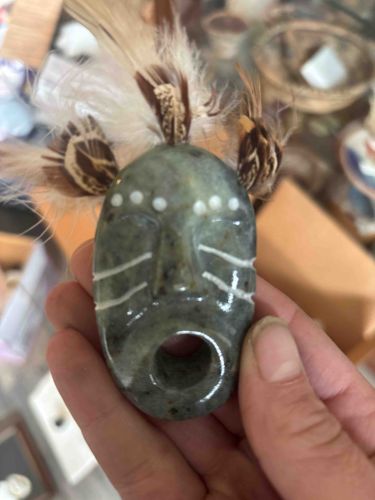
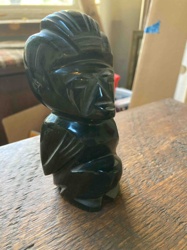
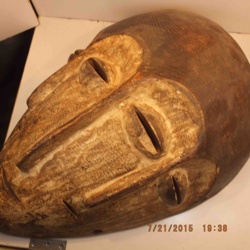
The item is a small, hand-carved mask or face sculpture, likely intended as a pendant, charm, or miniature art piece. It appears to be carved from a single piece of dark green stone, possibly jade or a similar serpentine variety, given the 'Alaskan Native Art' context. The stone exhibits mottled grey-green coloration with darker inclusions and lighter striations, indicative of its natural mineral composition. The surface is polished, giving it a smooth, glossy finish, although some minor surface irregularities or natural stone variations are visible. The carving depicts an abstract human-like face. Notable features include carved-out eye sockets, a somewhat triangular nose, and a prominent, circular mouth Opening that extends through the entire thickness of the piece, suggesting it could also function as a whistle or a passage for a cord. The face is adorned with what appears to be inlaid or painted white pigment detailing. There are five circular dots above each eye in an arc pattern, and two horizontal lines extending from the outer corners of each eye towards the 'cheeks'. These white markings contrast sharply with the dark green stone. Attached to the top of the 'head' are multiple small feathers, predominantly light cream or beige with dark brown and black speckled patterns, likely from a game bird such as a partridge or grouse. These feathers are secured together at their quills and inserted into a hole or attachment point at the top of the carved face, forming a small plume or headdress accessory. The craftsmanship suggests a hand-carved piece, with visible tool marks within the recessed areas of the carving, particularly around the eyes and mouth. The overall condition appears good, with no obvious signs of significant damage like chips or cracks in the stone. The feathers appear intact, though their delicate nature means they are prone to wear over time. The style is indicative of indigenous art, specifically aligned with the 'Alaskan Native Art' context provided, suggesting it is a modern or vintage piece crafted in a traditional or inspired style. The quality of the carving is relatively fine, showcasing attention to detail in the facial features and the smooth finish of the stone, while retaining a rustic, handmade charm.
AI Appraisal Report
Upon examining this Alaskan Native style carved stone mask, my assessment is based on the visual information provided. The piece presents as a small pendant or sculpture, hand-carved from a dark green stone consistent with serpentine, a material commonly used in such crafts. The carving quality is competent, displaying a polished finish and distinctive inlaid or painted white detailing that creates a striking contrast. The addition of small game bird feathers as a headdress is a traditional design element. Based on its style and finish, this appears to be a contemporary or vintage tourist art piece, likely made in the late 20th century for the Alaskan souvenir market, rather than a ritually used or antique object.
The market for this type of Native-inspired art is active but value is highly dependent on the artist's reputation, specific materials, and provenance. Without a signature or documentation, it is categorized as 'artist unknown.' Comparable unsigned, contemporary stone carvings of this size and quality typically sell in a modest price range. The primary factors influencing its value are its aesthetic appeal and craftsmanship. Its value is limited by its likely status as a tourist-trade item and the lack of artist attribution.
It is crucial to note that a definitive authentication is impossible from images alone. A physical examination is required to confirm the type of stone (distinguishing serpentine from more valuable jade), to analyze the tool marks, and to verify the pigment and feather composition. True authentication would necessitate provenance documentation linking it to a specific artist or community, which would significantly increase its value.