AI estimate as of August 14, 2025 · verify with a professional before acting
AI-Generated · Verify before acting
Everything on this page is generated by AI for informational purposes only. AI can make mistakes — the AI may misidentify items or misattribute them (artist, maker, brand, designer, origin, era). This is not an official valuation and should not be used for insurance, sale, tax, estate, legal, or lending purposes — or any decision requiring a certified appraisal. It is not an authoritative claim about any person, brand, or rights holder — do not share or rely on it as a factual statement about a third party. Always consult qualified professionals before making financial decisions.
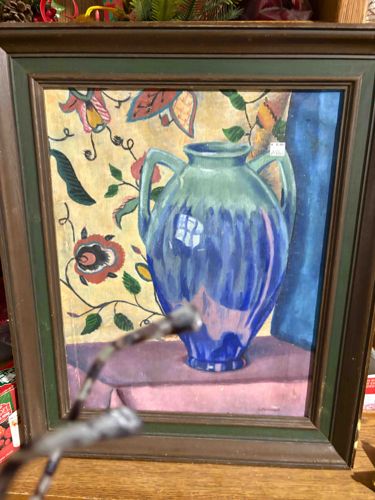
This item is a framed still-life painting featuring a prominent blue and green two-handled vase. The vase appears to be made of ceramic or glass, with visible brushstrokes indicating a textured or reflective surface, painted to show varying shades of blue and green, suggesting light reflection or an aged patina. The background behind the vase is a yellow/cream color adorned with a repeating floral pattern in red, orange, and green hues, reminiscent of folk art or Chinoiserie textiles. To the right of the vase, a solid blue element, possibly a draped fabric or background wall, provides a strong contrasting vertical line. The vase rests on a pink or light purple surface, which serves as the foreground. The painting is housed within a multi-layered wooden frame. The innermost layer is a dark green, followed by a gold-toned fillet, and an outermost dark brown or black wooden frame. The frame shows minor wear consistent with age, but no apparent major damage. The painting itself appears to be in good condition, with no visible tears or significant discoloration, suggesting it has been preserved well. The style of the painting, with its bold colors and somewhat flattened perspective, hints at an early to mid-20th-century aesthetic, possibly influenced by Modernist or Folk Art movements. The craftsmanship of the painting is indicative of a skilled artist, though no clear signature or manufacturing marks are visible in the provided image.
AI Appraisal Report
I have examined the provided image of the framed still-life painting featuring a blue-green vase. Based on this visual inspection, the painting appears to be in very good condition, showing no visible tears, significant discoloration, or major damage, suggesting proper preservation. The frame, while robust and multi-layered (dark green, gold fillet, dark brown/black wood), exhibits only minor wear consistent with its likely age, which does not detract significantly from the piece.
The style, characterized by bold colors, a somewhat flattened perspective, and repeating floral patterns in the background, strongly suggests an early to mid-20th-century aesthetic, potentially influenced by Modernist, Folk Art, or even Chinoiserie movements. This indicates a skilled artist, although no signature or identifying marks are discernible from the image, which is a key limitation.
Market conditions for unsigned decorative still-life paintings from this period are generally stable. Comparables would include similar period works by unknown or lesser-known artists, often sold in regional auction houses or reputable antique shops. The strong aesthetic appeal, good condition, and charming subject matter contribute positively to its marketability.
Demand for such pieces is moderate, driven by collectors of period decorative art and individuals seeking unique interior accents. While not rare in the sense of a masterwork, its individual charm and condition give it some distinction. The primary factor limiting a higher valuation is the absence of a discernible artist's signature or provenance, which prevents authentication to a specific artist or attribution to a known movement beyond stylistic inferences. Without a signature, its rarity is assessed solely on its visual attributes rather than artistic origin.
My assessment of authenticity is limited to what is visible. To definitively authenticate the piece, establish its artist, or confirm its precise age and origin, an in-person physical examination would be crucial. This would allow for close inspection of brushwork, paint layers, stretcher construction (if applicable), and frame details. Furthermore, provenance documentation (e.g., previous ownership records, exhibition history) and potentially scientific testing (e.g., pigment analysis, carbon-dating for extreme cases) would be invaluable for full authentication and to unlock its maximum potential value.