These notes were written by the person who submitted this item. Appraiser.AI has not verified them, and the AI's identification and estimate may rely on them.
AI Estimated Value
Not an official valuation
$25-50
AI estimate as of June 21, 2025 · verify with a professional before acting
AI-Generated · Verify before acting
Everything on this page is generated by AI for informational purposes only. AI can make mistakes — the AI may misidentify items or misattribute them (artist, maker, brand, designer, origin, era). This is not an official valuation and should not be used for insurance, sale, tax, estate, legal, or lending purposes — or any decision requiring a certified appraisal. It is not an authoritative claim about any person, brand, or rights holder — do not share or rely on it as a factual statement about a third party. Always consult qualified professionals before making financial decisions.
This analysis also relies on unverified notes provided by the user, which may be incomplete or inaccurate and could affect the result.
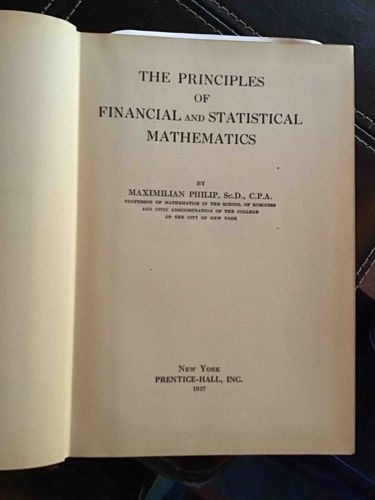
The item is a vintage hardcover book titled "The Principles of Financial and Statistical Mathematics" by Maximilian Philip, Sc.D., C.P.A. The visible page is the title page, made of a cream or off-white paper that shows some age-related toning, indicating its vintage nature. The text is printed in black ink in a clear, seriffed typeface. The layout is centered, presenting the title prominently, followed by the author's name and credentials. Below the author's name, there is a smaller block of text, partially visible, which appears to describe his professional affiliations as "Professor of Mathematics at the School of Business and Civic Administration of the College of The City of New York." At the bottom of the page, the publisher information is visible: "New York Prentice-Hall, Inc. 1937", clearly dating the publication to 1937. The paper itself seems to be of a decent quality for its era, with a slightly textured appearance. There are no obvious tears, creases, or major stains visible on this page, suggesting a good overall condition for its age. The binding edge on the left shows a slight curve, indicating it is an open book. The craftsmanship aligns with standard book production of the mid-20th century. The page has a uniform degree of aging, suggesting it has been stored in a relatively stable environment.
AI Appraisal Report
Based on my examination of the provided image and description, this 1937 first edition of "The Principles of Financial and Statistical Mathematics" by Maximilian Philip appears to be in good condition for its age. The title page shows expected age-related toning, but no significant tears, creases, or major stains, which aligns with the owner's assessment. The clear publisher and date information aid in confirming its authenticity as a 1937 printing.Factors impacting value for this book are primarily its age, condition, and its niche subject matter. While it is a vintage academic text, it does not typically attract widespread collector interest. The demand for such a specific, early-20th-century mathematics textbook is limited to a small audience of academic libraries, financial historians, or specialized collectors. There is no indication of particular rarity associated with this title.When considering comparables, similar academic texts from the same era, especially those not considered seminal works or by highly prolific/famous authors, tend to fetch modest prices. Without a physical inspection, however, I cannot definitively assess the integrity of the binding beyond the visible title page, the presence of marginalia, foxing, or other internal damage that might affect its value. Full authentication would ideally involve a physical examination for complete condition assessment and to check for any hidden defects.Provenance documentation, such as original purchase receipts or ownership history, would provide additional layers of authentication, though for a book of this nature, it is not typically expected and would not significantly alter the primary value. Scientific testing is generally not required for book authentication unless there are specific concerns about paper, ink, or binding materials, which are not apparent here.Its value is largely contingent on its appeal to a niche market rather than broad collector demand.