AI estimate as of August 2, 2025 · verify with a professional before acting
AI-Generated · Verify before acting
Everything on this page is generated by AI for informational purposes only. AI can make mistakes — the AI may misidentify items or misattribute them (artist, maker, brand, designer, origin, era). This is not an official valuation and should not be used for insurance, sale, tax, estate, legal, or lending purposes — or any decision requiring a certified appraisal. It is not an authoritative claim about any person, brand, or rights holder — do not share or rely on it as a factual statement about a third party. Always consult qualified professionals before making financial decisions.
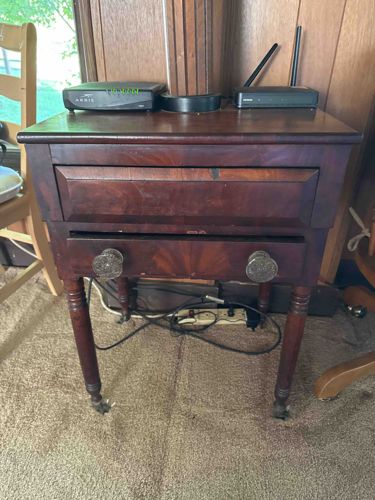
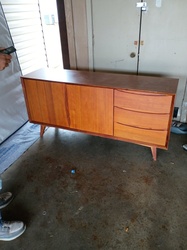
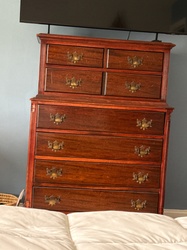
This item is an antique or vintage two-drawer side table, likely functioning as a nightstand or elegant occasional table. It appears to be constructed from a rich, reddish-brown wood, possibly mahogany or a similar dark-stained hardwood, exhibiting a distinct wood grain, especially on the drawer fronts (possibly crotch mahogany veneer or a figured grain pattern). The top surface is flat with a subtle rounded edge, showing some signs of wear and possibly water marks or discoloration in the form of a lighter, faded area near the front left. The table features two drawers, with the top drawer appearing to be a single, wider drawer, while the bottom drawer is also wide. Both drawers feature an inset panel design, adding depth and shadow lines. The pulls on the bottom drawer are round, ornamental, and possibly made of glass or an early form of pressed metal with a decorative pattern, displaying a silvery or patinated finish. The legs are turned, slender, and fluted or reeded at the top, transitioning to an unadorned lower section before terminating in casters with metal lion paw feet, indicative of furniture from the mid-19th century or early 20th century, possibly in the Empire or Victorian style. The overall finish shows a discernible patina consistent with age, with minor scuffs and surface wear visible, particularly on the edges and corners. There are no visible major cracks or structural damage from the provided angle, but the finish is not uniformly glossy, suggesting years of use and original finish wear. The construction appears solid, with no loose joints immediately evident, though the presence of modern electronics on top indicates it's still in active use.
AI Appraisal Report
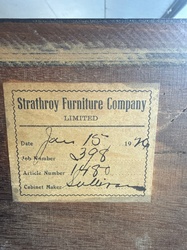
Upon my virtual examination of this two-drawer side table, I assess its condition as good vintage with typical signs of age. The rich, reddish-brown wood, likely mahogany or a similar hardwood, exhibits an attractive patina. Wear on the top surface, including potential water marks, and scuffs on edges and corners are consistent with its age and use. The turned legs with reeding and casters terminating in metal lion paw feet strongly suggest a mid-19th to early 20th-century origin, possibly aligning with Empire or Victorian styles. The inset panel drawers and ornamental pulls further support this period attribution. Authenticity cannot be definitively confirmed without a physical inspection. An in-person examination would allow me to assess the construction methods (dovetails, joinery), wood species, and the true material and construction of the pulls. Provenance documentation could provide crucial historical context, while scientific testing (e.g., carbon dating for the wood, metallurgical analysis for hardware) would offer irrefutable authentication, though rarely pursued for items in this value range. Market conditions for antique side tables vary. While general antique furniture has seen fluctuating demand, pieces with distinctive features like these lion paw casters often retain a niche appeal. Comparable pieces with similar stylistic elements and condition typically sell in the upper hundreds to low thousands depending on provenance and specific craftsmanship. This item's appeal lies in its decorative quality and functionality as a unique accent piece. The wear on the surface slightly impacts value, but it does not deter from its charm or structural integrity. Demand is moderate, appealing to those seeking period-specific or eclectic furnishings. Its rarity is modest; while not unique, this specific combination of features is less common than generic antique tables.