AI estimate as of September 16, 2025 · verify with a professional before acting
AI-Generated · Verify before acting
Everything on this page is generated by AI for informational purposes only. AI can make mistakes — the AI may misidentify items or misattribute them (artist, maker, brand, designer, origin, era). This is not an official valuation and should not be used for insurance, sale, tax, estate, legal, or lending purposes — or any decision requiring a certified appraisal. It is not an authoritative claim about any person, brand, or rights holder — do not share or rely on it as a factual statement about a third party. Always consult qualified professionals before making financial decisions.
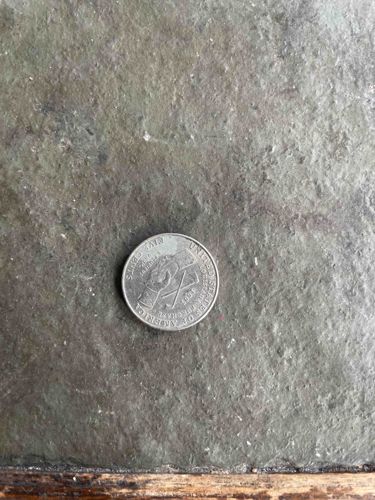
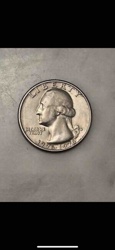
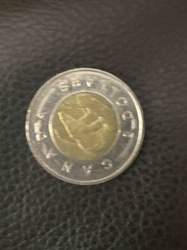
The item is a silver-colored coin, appearing to be a United States quarter, specifically from the 50 State Quarters Program. The visible side of the coin, the reverse (tail side), clearly displays elements pertaining to the state of Delaware. In the center, there is an image of Caesar Rodney on horseback, charging forward. Below the horse, inscriptions read 'CAESAR RODNEY' and 'DELAWARE'. The date '1787' is also visible, signifying the year Delaware ratified the U.S. Constitution. Surrounding the central image are the words 'THE FIRST STATE' at the top, and '1999 E PLURIBUS UNUM' at the bottom. The legend 'UNITED STATES OF AMERICA QUARTER DOLLAR' is also visible along the coin's rim. The coin exhibits a relatively circulated condition, with some surface wear visible, particularly on the higher points of the design such as Rodney's hat and the horse's head, suggesting it has been in active use. There are no obvious signs of significant damage like deep scratches or corrosion, but the overall luster appears somewhat dulled, indicating a natural patina from age and handling. This quarter is part of a series that began in 1999, making this particular coin an early issue from the program. The coin's diameter is consistent with a standard U.S. quarter, approximately 24.26 mm (0.955 inches) and its composition would typically be a clad copper-nickel alloy. The craftsmanship is typical of mass-produced circulating coinage from the U.S. Mint, with clear but not exceptionally sharp details due to wear.
AI Appraisal Report
I have examined the provided image of what appears to be a 1999 Delaware State Quarter. Based on this visual inspection, the coin exhibits characteristics typical of genuine United States Mint coinage from the 50 State Quarters Program. The design elements, including Caesar Rodney on horseback, the inscriptions 'CAESAR RODNEY', 'DELAWARE', '1787', 'THE FIRST STATE', '1999 E PLURIBUS UNUM', and 'UNITED STATES OF AMERICA QUARTER DOLLAR', are all consistent with authentic examples of this quarter. The coin's composition, as a standard clad copper-nickel alloy, is also typical for circulating currency and cannot be fully confirmed without physical testing. The condition appears to be circulated, with noticeable wear on higher points like Rodney's hat and the horse's head, and a dulled luster. There are no indications of significant damage or alteration. These quarters were minted in very high quantities, with the Philadelphia Mint producing 373,400,000 and the Denver Mint producing 413,800,000 for the Delaware issue alone. Due to their mass production and commonality, these coins typically hold only their face value in circulated condition. In-person examination would be needed to precisely grade the coin and confirm its metallic composition and weight; however, given its circulated state, even a high-grade circulated example would not command a significant premium. Without physical inspection, I cannot rule out the possibility of it being a counterfeit, though the likelihood is low for a circulating quarter. Full authentication would require in-hand examination, including weight and diameter measurements, and potentially spectroscopic analysis to confirm alloy composition.