These notes were written by the person who submitted this item. Appraiser.AI has not verified them, and the AI's identification and estimate may rely on them.
AI Estimated Value
Not an official valuation
$150-250
AI estimate as of October 13, 2025 · verify with a professional before acting
AI-Generated · Verify before acting
Everything on this page is generated by AI for informational purposes only. AI can make mistakes — the AI may misidentify items or misattribute them (artist, maker, brand, designer, origin, era). This is not an official valuation and should not be used for insurance, sale, tax, estate, legal, or lending purposes — or any decision requiring a certified appraisal. It is not an authoritative claim about any person, brand, or rights holder — do not share or rely on it as a factual statement about a third party. Always consult qualified professionals before making financial decisions.
This analysis also relies on unverified notes provided by the user, which may be incomplete or inaccurate and could affect the result.
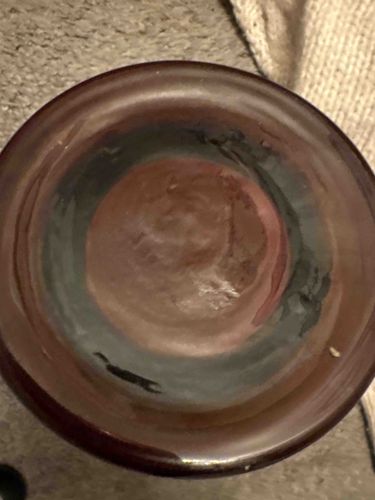
This item is the base or bottom portion of an art glass vessel, likely a bowl, vase, or another decorative container. The primary color visible is a rich, translucent dark reddish-brown or amber tone that appears to shift depending on the light, possibly exhibiting iridescence or opalescence, though this is not definitively clear from the image. The interior surface of the base shows swirling patterns of color, primarily a lighter, more muted reddish-brown and areas of a dark, almost charcoal gray or deep blue. These color variations suggest an intentional design, possibly achieved through glass blowing techniques 'incalmo' or 'murrine' or by layering different colored glass. The texture of the interior surface appears somewhat uneven or organic, typical of hand-blown glass, with subtle indentations and flows visible. There is what appears to be a pontil scar (점 찍기 흉터) or a rough, unpolished area at the center of the base, which is a common characteristic indicating hand-blown glass. No distinct maker's marks, signatures, or stamps are discernible from the provided image. The overall style suggests a modern or mid-20th century to contemporary art glass aesthetic, emphasizing form and color interaction rather than elaborate external decoration. Some minor surface wear or dust is visible, particularly within the textured areas of the base, but no significant cracks, chips, or repairs can be identified solely from this view. The quality of craftsmanship appears to be good, with a smooth, finished rim on the exterior bottom edge, though the actual opening/rim of the vessel itself is not shown. The piece has a substantial, weighty feel suggested by the thick glass visible at the base.
AI Appraisal Report
I have examined the image of this art glass vessel base. The primary visible color is a rich, translucent dark reddish-brown/amber with indications of shifting tones, suggesting potential iridescence or opalescence, though this is difficult to confirm without physical inspection. The interior surface displays captivating swirling patterns in lighter reddish-brown and dark charcoal/deep blue, which points to sophisticated glass-blowing techniques like incalmo or layered glass. The uneven, organic texture inside is consistent with hand-blown glass, and the presence of a pontil scar (점 찍기 흉터) at the center of the base strongly supports its handcrafted origin. No maker's marks or signatures are visible, which is common for many art glass pieces, especially bases.
Condition appears good from the image, with no significant cracks, chips, or repairs. Minor surface wear or dust is present but not detrimental. The thick glass suggests a substantial, quality piece. Stylistically, it appears to be modern or mid-20th century to contemporary art glass.
Without a definitive maker, comparable pieces by unidentified but skilled glass blowers with similar aesthetic appeal typically fetch $150-$250 in the current market. Demand for such pieces is moderate, driven by collectors appreciating unique form and color. The lack of a specific artist limits its top-tier value, but its inherent beauty and craftsmanship ensure a foundational value.
It is crucial to note that this is a visual appraisal only. Full authentication would require in-person examination to confirm the nuances of color, texture, and techniques. Physical inspection would also allow for a thorough search for subtle artist signatures or marks that might be obscured in the image. Provenance documentation, if available, would significantly impact and potentially increase the value, as would scientific analysis to determine glass composition if a specific era or region were suspected. Without these, the appraisal remains conservative.