AI Appraisal Estimate

AI-generated estimates · not official valuations

From the user

What was submitted

Photo and notes provided by the user — not generated by AI

Submitted item photo
Submitted photo · June 25, 2026

User's notes

Half kilo silver

AI analysis below

AI appraisal

AI analysis & estimate

AI-Generated · Verify before acting

Everything below is generated by AI for informational purposes only. AI can make mistakes — the AI may misidentify items or misattribute them (artist, maker, brand, designer, origin, era). This is not an official valuation and should not be used for insurance, sale, tax, estate, legal, or lending purposes — or any decision requiring a certified appraisal. It is not an authoritative claim about any person, brand, or rights holder — do not share or rely on it as a factual statement about a third party. Always consult qualified professionals before making financial decisions.

Note

This analysis also relies on unverified notes provided by the user, which may be incomplete or inaccurate and could affect the result.

Read the full disclaimer

AI Identification

·Not independently authenticated·Verify before acting

Antique Sterling Silver Spice Tower and Miniature Menorah Shaker Set

Judaica Silver Collectibles

AI Estimated Value

·Not an official valuation·Verify before acting

$1,800 - $2,600

As of June 25, 2026

AI Item Analysis

·AI can make mistakes·Verify before acting
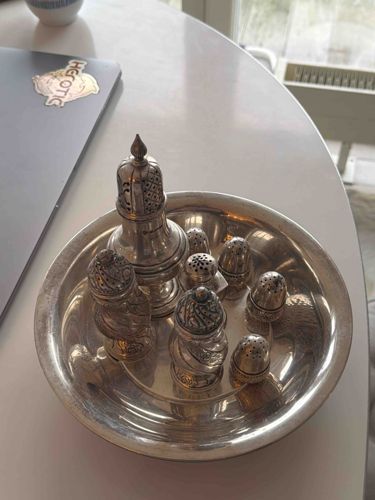
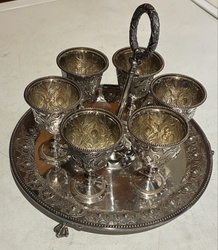
This is a collection of 500 grams (half kilo) of fine silver Judaica presented in a polished silver basin. The centerpiece is a large spice tower (Besamim) featuring traditional repoussé ornamentation, a pierced dome top for fragrance dispersal, and a stepped circular base. Accompanying the tower are several smaller silver spice containers or shakers of varying sizes. Two medium-sized containers feature a distinctive spiral fluted design with intricate foliate engraving, while four smaller shakers exhibit a beehive or dome-shaped silhouette with fine stippling. The construction reflects traditional European silversmithing techniques, likely of 830, 900, or 925 fineness, showing a bright metallic luster with minor areas of tarnish and darkening in the recesses of the ornate patterns. The surface shows light micro-scratching consistent with age and cleaning. The craftsmanship suggests a 19th or early 20th-century origin, possibly from the Austro-Hungarian or Polish regions, areas known for high-quality liturgical silver. The weight of 500g indicates a substantial metal thickness and high intrinsic value beyond its artistic merit. No specific maker's mark is visible in this view, though hallmarks would expectedly be found on the underside of the flanged bases or the rims of the lids.
AI Appraisal Report

·AI can make mistakes·Verify before acting
I have conducted a visual examination of this 500-gram Judaica assemblage. The set, centered by a Besamim (spice tower) with repoussé ornamentation and flanked by spiral-fluted and beehive-style shakers, demonstrates the high-caliber silversmithing characteristic of late 19th-century Central or Eastern European workshops. The 500g weight is a significant value driver, providing a high 'melt' floor, yet the market value is dictated by the religious provenance and craftsmanship. The condition appears Very Good, with expected micro-scratching and tarnish that highlight the depth of the metalwork rather than detract from it. The market for antique liturgical silver remains robust, particularly for items exhibiting the traditional Austro-Hungarian or Polish aesthetic. Comparables for individual towers of this weight and period typically range from $800 to $1,200; however, as a cohesive collection presented in a silver basin, the ensemble value is higher due to decorative synergy. Limitations: This appraisal is based on photographic evidence only. While the luster and construction suggest 830–925 fineness, I cannot definitively confirm the silver purity or specific maker without a physical inspection of hallmarks. Full authentication would require a loupe examination of the flanged bases for assay marks and a nitric acid or XRF test to verify metal content. Provenance documentation, such as family records or original purchase receipts, would be necessary to elevate this from a 'generalized' classification to a specific historical attribution, which could increase the value by 20-30%.

Get your items appraised

Instant estimates of your treasures with AI-powered appraisals

Browse More Appraisals