AI estimate as of September 27, 2025 · verify with a professional before acting
AI-Generated · Verify before acting
Everything on this page is generated by AI for informational purposes only. AI can make mistakes — the AI may misidentify items or misattribute them (artist, maker, brand, designer, origin, era). This is not an official valuation and should not be used for insurance, sale, tax, estate, legal, or lending purposes — or any decision requiring a certified appraisal. It is not an authoritative claim about any person, brand, or rights holder — do not share or rely on it as a factual statement about a third party. Always consult qualified professionals before making financial decisions.
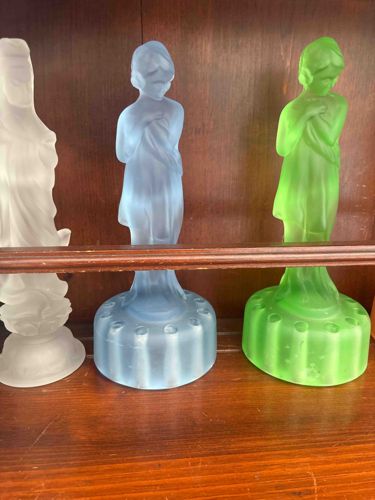
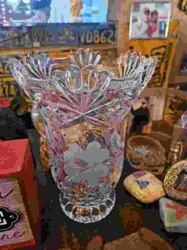
This image displays a collection of three frosted glass figural pieces, appearing to be elegant vanity or boudoir items from the Art Deco period. Specifically, two identical 'nude woman' figural powder jars are captured prominently: one in a soft, ethereal frosted blue and the other in a vibrant, translucent frosted green, possibly uranium glass due to its bright hue. A third, partially visible frosted white figural, distinct from the other two, can be seen on the far left. The 'nude woman' figures are depicted in a classical pose, with flowing drapery modestly covering parts of their bodies. Their features are softened by the frosted finish of the glass, creating a delicate and artistic aesthetic. Each figure stands atop a circular base which appears to be designed as a powder jar, featuring a series of raised, circular indentations or 'pearls' around the perimeter of the lid, likely for holding dusting puffs or as decorative elements. The craftsmanship suggests molded or pressed glass, characteristic of the early to mid-20th century. The consistent style and frosted appearance across the pieces indicate they may be part of a set or from the same manufacturer. No visible damage such as chips or cracks can be discerned from the image, and the frosted finish appears consistent with moderate age, suggesting good preservation. The items represent typical Art Deco stylistic preferences for elegant female forms and functional decorative objects.
AI Appraisal Report
Based on my visual examination of the provided image, I am assessing this collection of Art Deco Frosted Glass Nude Woman Figural Powder Jars. The two prominent 'nude woman' powder jars, one in frosted blue and the other in frosted green (with the green possibly being uranium glass, though this cannot be confirmed visually), appear to be in very good condition. I do not observe any visible chips, cracks, or significant wear to the frosting or details, which is crucial for glassware of this age. The third, partially visible white figural also appears well-preserved.
Authenticity is strongly suggested by the characteristic Art Deco styling, classical poses, and manufacturing techniques evident in the forms and detail, consistent with molded or pressed glass production of the early to mid-20th century. Such designs were popular for vanity items during that era. The frosted finish on all pieces appears uniform and original, indicative of careful preservation or high-quality manufacturing.
Market conditions for Art Deco vanity items, particularly figural glass pieces, are generally stable, with a consistent demand from collectors of Decorative Arts and Art Deco period pieces. Comparables for individual frosted glass figural powder jars of similar quality and condition typically range from $150 to $250 each. The presence of two identical figures in different desirable colors, plus a third figural, adds to the collection’s appeal and potential value as a set.
Demand for these specific figural forms remains moderate to strong among dedicated collectors. Rarity can vary by manufacturer and specific mold; without makers’ marks, precise rarity is hard to determine. Factors positively impacting value are the excellent condition, the desirable Art Deco aesthetic, and the two distinct colors. The potential for the green piece to be uranium glass would significantly enhance its individual value.
Limitations in authenticity verification are inherent in image-based appraisals. While the visual evidence is compelling, a full authentication would require in-person examination to confirm the absence of subtle flaws, repairs, or reproductions. Physical inspection would allow me to check for makers' marks, assess the exact quality of the glass and frosting, and confirm if the green glass fluoresces under UV light, thereby confirming if it is indeed uranium glass. Provenance documentation, if available, would also provide a definitive history of ownership and origin.