These notes were written by the person who submitted this item. Appraiser.AI has not verified them, and the AI's identification and estimate may rely on them.
AI Estimated Value
Not an official valuation
$30-60
AI estimate as of September 29, 2025 · verify with a professional before acting
AI-Generated · Verify before acting
Everything on this page is generated by AI for informational purposes only. AI can make mistakes — the AI may misidentify items or misattribute them (artist, maker, brand, designer, origin, era). This is not an official valuation and should not be used for insurance, sale, tax, estate, legal, or lending purposes — or any decision requiring a certified appraisal. It is not an authoritative claim about any person, brand, or rights holder — do not share or rely on it as a factual statement about a third party. Always consult qualified professionals before making financial decisions.
This analysis also relies on unverified notes provided by the user, which may be incomplete or inaccurate and could affect the result.
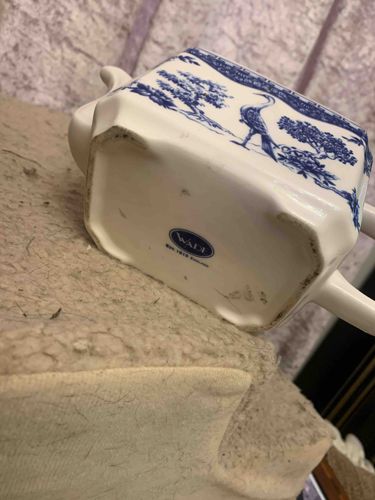
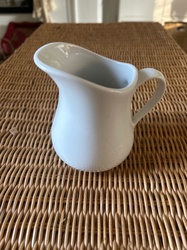
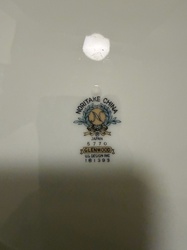
This is a ceramic or porcelain pitcher, predominantly white with a distinct blue and white chinoiserie or transferware pattern. The pitcher has an octagonal or faceted body with sharp, defined corners. The handle and spout are not fully visible but appear to be integrated into the design. The blue decoration features a classic oriental landscape scene, including stylized trees, foliage resembling willows or pines, and a prominent heron or crane bird standing amidst the scenery. The bird is depicted with a long neck and legs, characteristic of wading birds found in traditional Asian art. Along the top rim of the pitcher, a border of blue foliage or an intricate pattern is visible. The underside of the pitcher clearly displays a manufacturer's mark: a blue oval stamp with the word "WAEE" in a distinctive font, and underneath it, the text "Est. 1829 England." This mark indicates the item was produced by Wade Ceramics, a well-known British pottery manufacturer. There are visible signs of age and wear, particularly along the bottom edges and corners where some discoloration and small chips or rough patches are present, suggesting use over time. The ceramic material appears glazed, giving it a smooth, semi-glossy finish. The craftsmanship suggests a commercially produced item, likely from the mid-20th century or later, given the clear and consistent application of the transferware pattern. The design theme is timeless, mimicking traditional oriental porcelain, which indicates a decorative as well as functional purpose.
AI Appraisal Report
Based on my examination of the provided image and information, I assess this Wade Blue and White Chinoiserie Porcelain Pitcher. Authenticity is strongly supported by the clear 'WAEE Est. 1829 England' backstamp, which is characteristic of Wade Ceramics. The octagonal form and transferware decoration align with known Wade production, particularly their Chinoiserie or Oriental-inspired patterns. The pattern, featuring a heron/crane in a landscape, is a classic motif often seen in items intended to mimic traditional Asian porcelain.
Regarding condition, I observe visible signs of age and use, specifically discoloration and small chips/rough patches along the bottom edges and corners. While the glaze appears intact across most of the body, these imperfections detract slightly from its overall desirability. The clarity and consistency of the transferware pattern, despite the minor wear, indicate a commercially produced item. My assessment of the production period would place this likely in the mid to late 20th century, common for Wade's decorative wares.
Market conditions for Wade ceramic pitchers of this type are generally stable but not highly buoyant. While collectible, these items are relatively common. Comparables in similar condition typically fall within a modest range. Demand is primarily from collectors of Wade ceramics or those seeking decorative Chinoiserie items. Rarity is not a significant factor here, as Wade produced these in substantial quantities. The primary factors impacting value are the Wade provenance, the attractive blue and white Chinoiserie pattern, and its functional form, balanced against the visible condition issues.
It is important to note that this assessment is based solely on visual examination of the provided image. Limitations in verifying authenticity from images alone mean I cannot definitively confirm every aspect without physical inspection. An in-person examination would allow for a tactile assessment of the ceramic body for any hidden cracks or repairs, a more precise evaluation of wear (e.g., specific chip sizes, glaze crazing not discernible from the photo), and a comprehensive check of the backstamp for any subtleties that might indicate a reproduction. Without touching the piece, I cannot fully ascertain its weight or the exact finish of the glaze, which could sometimes offer further clues to its age and quality. Provenance documentation beyond the visible mark would also be beneficial for a complete history, though not strictly necessary for this type of well-marked commercial item.