These notes were written by the person who submitted this item. Appraiser.AI has not verified them, and the AI's identification and estimate may rely on them.
AI Estimated Value
Not an official valuation
$40-90
AI estimate as of September 16, 2025 · verify with a professional before acting
AI-Generated · Verify before acting
Everything on this page is generated by AI for informational purposes only. AI can make mistakes — the AI may misidentify items or misattribute them (artist, maker, brand, designer, origin, era). This is not an official valuation and should not be used for insurance, sale, tax, estate, legal, or lending purposes — or any decision requiring a certified appraisal. It is not an authoritative claim about any person, brand, or rights holder — do not share or rely on it as a factual statement about a third party. Always consult qualified professionals before making financial decisions.
This analysis also relies on unverified notes provided by the user, which may be incomplete or inaccurate and could affect the result.
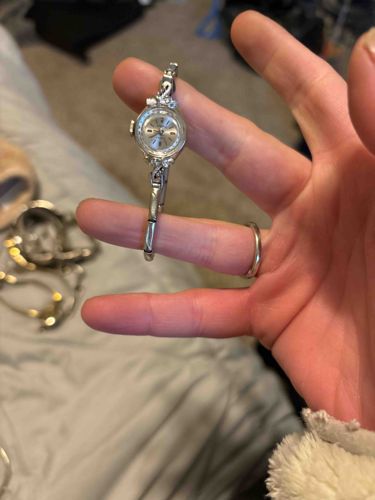
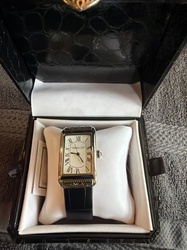
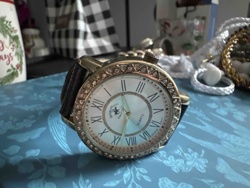
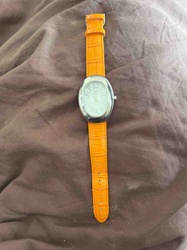
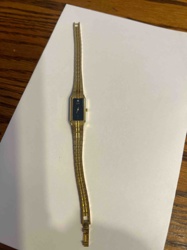
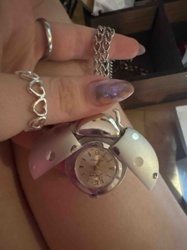
This is a vintage ladies' cocktail watch, likely dating from the mid-20th century, possibly 1940s-1960s, given its delicate and decorative design. The watch features a small, round silver-toned dial with hour markers that appear to be a mix of Arabic numerals (at 12, 3, 6, 9 o'clock) and possibly dots or small indices for the other hours, although this is not entirely clear from the image. The hands are slender and silver-toned. The watch case itself is relatively small and rounded, set within an ornate, silver-toned metal surround that extends into the bracelet. The prominent features of this watch are the decorative flourishes on either side of the watch face. These appear to be scrollwork or stylized floral designs, possibly accented with small, clear stones (simulated diamonds or crystal) that add a sparkling effect. The bracelet is a flexible expansion or link style, also in a silver tone, with slender elongated rectangular links. It has a slightly stretched or worn appearance. The overall metal finish is consistent, suggesting it might be white gold-filled, sterling silver, or a chrome-plated base metal. The size indicates it's designed for a petite wrist. There are no clear manufacturer's marks visible in the image. The dial is somewhat aged, showing a slightly dulled or patinated appearance, and there might be some minor surface scratches on the crystal, though a close inspection would be needed to confirm. The craftsmanship appears to be typical of mass-produced jewelry watches of its era, aiming for elegance and sparkle rather than high horological precision. The specific brand mentioned as context, 'Zodiac,' is known for wristwatches, but without a visible dial or case back marking, it's not possible to definitively attribute this watch to Zodiac.
AI Appraisal Report
Based on my examination of the images provided, this vintage ladies' cocktail watch appears to be a mid-20th century piece, likely dating from the 1940s-1960s. The design, featuring a small dial and decorative silver-toned scrollwork set with clear stones, is characteristic of mass-market watches from that era. The watch shows signs of age and wear consistent with its vintage, including a slightly patinated dial and a stretched expansion bracelet. Without clear maker's marks visible, attributing it directly to Zodiac is not possible based on the image alone; it aesthetically aligns more with numerous accessible brands of its time.
The market for such non-precious metal, decorative vintage watches is generally driven by aesthetic appeal rather than horological significance. Comparables for similar unbranded or lesser-known brand cocktail watches in silver-tone metal (often chrome plate or steel) from this period typically trade in the $40 to $90 range, depending on working condition and cosmetic appearance. The primary value determiners for this piece are its decorative quality and its function as a costume jewelry item. Its value is significantly limited by the unconfirmed brand identity, the likelihood of it being made from a base metal rather than precious metal like gold or platinum, and the use of simulated stones.
For a full appraisal, a physical, in-person examination is essential. This would allow me to test the metal content, identify the type of stones, inspect the watch movement for functionality and maker's marks, and confirm the brand on the dial and case back. Without this direct inspection, my assessment relies solely on visual queues and attribution remains unverified.