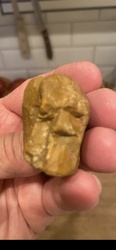
Weathered Chert or Flint Stone Fragment
Geological Specimens / Natural Stones

Weathered Chert or Flint Stone Fragment

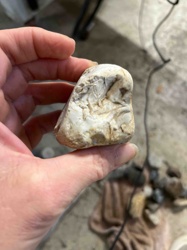
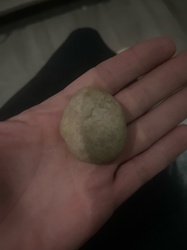
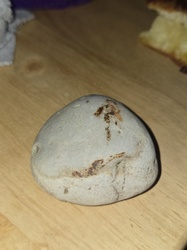
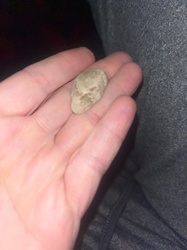
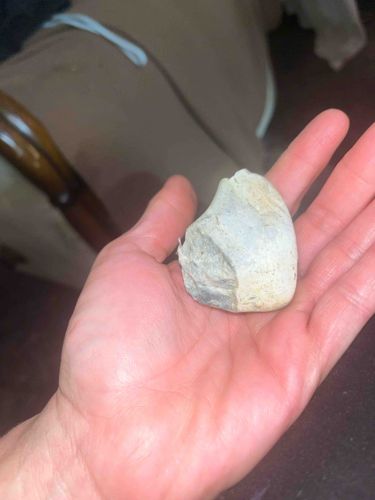
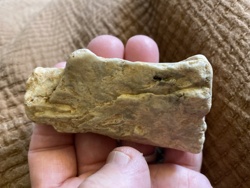
This item is a natural stone fragment, likely composed of chert or flint, held in a person's palm for scale. It measures approximately two inches in length and features an irregular, wedge-like shape. The color palette is a mix of light grayish-white on the smoother, weathered exterior surfaces, transitioning to a deeper, dull gray on the fractured or broken faces. The texture is variably smooth and pitted on the outer 'cortex' (the light-colored outer layer of the original nodule), while the freshly exposed surfaces show a sub-conchoidal fracture pattern typical of silica-rich rocks, though the edges appear dull and weathered rather than sharp. There are no visible maker's marks, signatures, or intentional flaking typical of human-made lithic tools like scrapers or arrowheads; the breaks appear to be the result of natural geological processes such as freeze-thaw cycles or mechanical tumbling. Small rust-colored oxidative stains are visible on certain edges, likely resulting from mineral deposits or proximity to soil. The overall condition is naturally distressed, with many micro-cracks and a dusty patina. It lacks the deliberate symmetry or retouching seen in archaeological artifacts, suggesting it is a naturally occurring geological specimen rather than a cultural object.
Estimated Value

$1.00 - $5.00

Basic Information

Category

Geological Specimens / Natural Stones

Appraised On

April 4, 2026

Estimated Value

$1.00 - $5.00

Item Description

This item is a natural stone fragment, likely composed of chert or flint, held in a person's palm for scale. It measures approximately two inches in length and features an irregular, wedge-like shape. The color palette is a mix of light grayish-white on the smoother, weathered exterior surfaces, transitioning to a deeper, dull gray on the fractured or broken faces. The texture is variably smooth and pitted on the outer 'cortex' (the light-colored outer layer of the original nodule), while the freshly exposed surfaces show a sub-conchoidal fracture pattern typical of silica-rich rocks, though the edges appear dull and weathered rather than sharp. There are no visible maker's marks, signatures, or intentional flaking typical of human-made lithic tools like scrapers or arrowheads; the breaks appear to be the result of natural geological processes such as freeze-thaw cycles or mechanical tumbling. Small rust-colored oxidative stains are visible on certain edges, likely resulting from mineral deposits or proximity to soil. The overall condition is naturally distressed, with many micro-cracks and a dusty patina. It lacks the deliberate symmetry or retouching seen in archaeological artifacts, suggesting it is a naturally occurring geological specimen rather than a cultural object.
Get Your Items Appraised

Instant estimates of your treasures with AI-powered instant appraisals

Browse More Appraisals