These notes were written by the person who submitted this item. Appraiser.AI has not verified them, and the AI's identification and estimate may rely on them.
AI Estimated Value
Not an official valuation
$40-80
AI estimate as of July 22, 2025 · verify with a professional before acting
AI-Generated · Verify before acting
Everything on this page is generated by AI for informational purposes only. AI can make mistakes — the AI may misidentify items or misattribute them (artist, maker, brand, designer, origin, era). This is not an official valuation and should not be used for insurance, sale, tax, estate, legal, or lending purposes — or any decision requiring a certified appraisal. It is not an authoritative claim about any person, brand, or rights holder — do not share or rely on it as a factual statement about a third party. Always consult qualified professionals before making financial decisions.
This analysis also relies on unverified notes provided by the user, which may be incomplete or inaccurate and could affect the result.
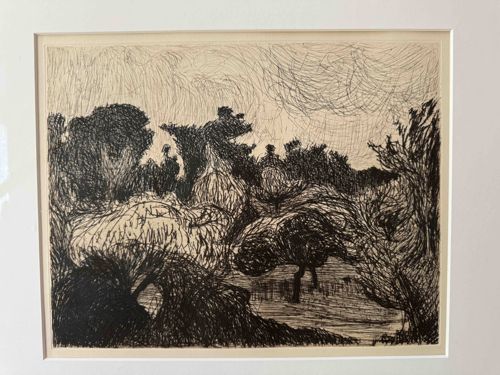
This item is an unframed, matted black and white linocut or woodcut print depicting a dense, somewhat abstract landscape or forest scene. The print itself measures approximately 10-12 inches wide by 8-10 inches high, matted within a larger white or off-white mat board to a dimension likely around 16x14 inches external. The primary medium appears to be black ink on a light, possibly off-white or cream-colored paper. The style is characterized by heavy, expressive lines and dense hatching, creating a strong contrast between the dark foliage/ground and the lighter sky. The trees and shrubs are rendered with energetic, swirling lines, suggesting movement or a windswept environment. In the background or midground, indistinct figures, possibly human, can be glimpsed amidst the thickets, adding a subtle narrative element. A body of water, perhaps a pond or stream, is visible in the lower right and center, rendered with horizontal lines indicating its surface. The print exhibits a hand-pulled quality, with slight variations in ink density inherent to relief printing processes. There are no clear maker's marks or signatures visible in the provided image, though they might be present outside the immediate print area or obscured by the mat. The overall impression is one of a turbulent, untamed natural scene. Visible condition issues include some general yellowing or discoloration of the paper consistent with age, contributing to a 'faded and worn' appearance as described. The print also shows signs of foxing or age spots, particularly in the lighter areas. The mat appears slightly discolored around the edges of the print opening, indicating exposure or age. The style suggests a period from the early to mid-20th century, possibly influenced by Expressionist or Post-Impressionist woodblock traditions. The craftsmanship, while not hyper-realistic, demonstrates confident linework and a strong compositional sense, indicative of a skilled printmaker.
AI Appraisal Report
I have examined the provided images of this black and white relief print, likely a linocut or woodcut, depicting a dense forest landscape. The style is expressive and dynamic, reminiscent of early to mid-20th century Expressionist printmaking. The composition is strong, with confident, swirling lines creating a turbulent and atmospheric scene. The presence of indistinct figures and a body of water adds narrative depth.
My assessment is based on a high-resolution digital image. The condition appears fair, consistent with the 'faded and worn' description. The paper shows age-related yellowing and foxing (small brown spots), and the mat is discolored. These condition issues significantly impact the value. The most critical factor determining value is the artist's identity. Without a visible signature or monogram, the print must be appraised as 'artist unknown.' While it demonstrates skill, the market for unattributed prints is limited.
Market comparables for skilled but anonymous 20th-century prints are modest, typically falling in the decorative art category. While a signed work by a known artist in this style (e.g., from the German Expressionist movement) could be worth several hundred or even thousands of dollars, this unsigned piece faces a much lower market demand.
Limitations: Authentication is impossible from images alone. A definitive appraisal requires in-person examination to assess the paper quality, printing technique, and to search for any hidden signatures, watermarks, or edition numbers. Provenance documentation or comparison with known works by a suspected artist would be necessary to establish authorship and significantly alter its value.