AI estimate as of August 18, 2025 · verify with a professional before acting
AI-Generated · Verify before acting
Everything on this page is generated by AI for informational purposes only. AI can make mistakes — the AI may misidentify items or misattribute them (artist, maker, brand, designer, origin, era). This is not an official valuation and should not be used for insurance, sale, tax, estate, legal, or lending purposes — or any decision requiring a certified appraisal. It is not an authoritative claim about any person, brand, or rights holder — do not share or rely on it as a factual statement about a third party. Always consult qualified professionals before making financial decisions.
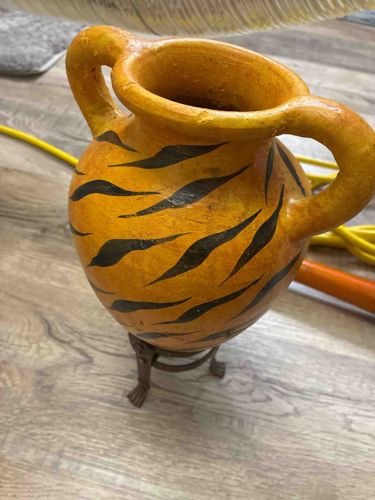
This item is a decorative amphora-style vase or urn, characterized by its vibrant faux tiger stripe pattern. The primary body of the vessel is a rich, warm orange or ochre color, adorned with irregular, hand-painted black stripes that mimic the markings of a tiger. The surface appears to be matte or slightly textured. The vase features a rounded, bulbous body tapering to a narrower neck and a flared rim. Two prominent, C-shaped handles are attached to the upper shoulders of the vase, extending upwards and attaching just below the rim. These handles appear to be integrally formed with the body of the vase. The construction material is likely earthenware, terracotta, or a similar ceramic, possibly with a painted or glazed finish that gives it the textured appearance. The visible condition shows some wear, particularly along the edges of the rim and handles, suggesting minor chips or rubbing that expose the underlying material, or merely showing inconsistencies in the finish application. There are no discernible maker's marks or signatures visible from the provided images. The vase is supported by a separate, possibly wrought iron or cast metal stand. This stand is dark-colored, likely black or dark brown, and features three ornate legs that terminate in paw-like or clawed feet, adding an exotic or antique-inspired touch to the overall presentation. The craftsmanship appears to be folk art or factory-produced decorative item, likely from the mid to late 20th century, given the style and material characteristics. The overall quality seems to be for decorative purposes rather than fine art pottery.
AI Appraisal Report
Upon examining the provided image of the Tiger Stripe Amphora-Style Vase with Claw-Foot Stand, I can offer the following appraisal. The condition of the vase appears fair to good for a decorative item of its likely age. There are visible inconsistencies and wear along the rim and handles, which could be minor chips, rubbing, or original imperfections in the finish. The matte, textured surface, combined with the hand-painted 'tiger stripe' motif, suggests a mid-to-late 20th-century decorative piece, possibly earthenware or terracotta. The separate three-legged stand with 'clawed' feet complements the exotic aesthetic.
Authenticity, in terms of its origin as a decorative item, seems consistent with the visual cues. However, without a physical examination, I cannot definitively determine the exact material composition, verify any potential hidden maker's marks, or assess all nuances of condition that might impact value further. Provenance documentation could shed light on its manufacturing origin or history, but for this type of item, it's rare to find extensive records. Scientific testing (e.g., material analysis) would be overkill for an item of this nature but could confirm specific ceramic types or paint components.
Market conditions for decorative ceramic items from the mid-20th century are generally stable but not high-demand unless attributed to a renowned maker or designer. This piece appears to be a mass-produced or folk-art item, primarily valued for its aesthetic appeal. Comparables for similar decorative urns or vases with stands in unique patterns, but without significant artistic provenance, typically range widely. The 'tiger stripe' is a distinctive feature that might appeal to specific niche collectors but doesn't necessarily elevate its rarity significantly. Its primary value is ornamental.
Factors impacting value include its decorative appeal, condition, size (though not fully ascertainable from the image), and the stability of the stand. The lack of a discernible maker's mark limits its collectible value to that of a general decorative accent. Demand is moderate, driven by interior design trends rather than art market speculation. It’s an interesting accent piece but not a high-value collectible.