AI estimate as of November 9, 2025 · verify with a professional before acting
AI-Generated · Verify before acting
Everything on this page is generated by AI for informational purposes only. AI can make mistakes — the AI may misidentify items or misattribute them (artist, maker, brand, designer, origin, era). This is not an official valuation and should not be used for insurance, sale, tax, estate, legal, or lending purposes — or any decision requiring a certified appraisal. It is not an authoritative claim about any person, brand, or rights holder — do not share or rely on it as a factual statement about a third party. Always consult qualified professionals before making financial decisions.
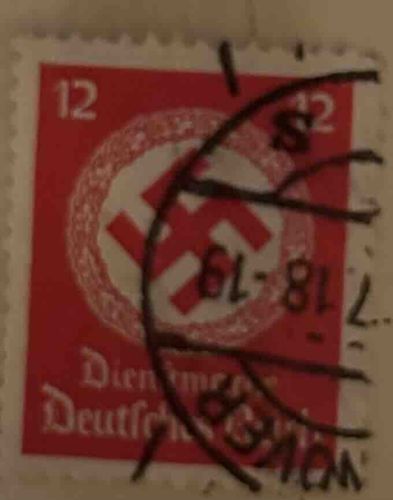
This item is a postage stamp, likely from the Nazi Germany era, judging by the prominent swastika symbol. The stamp is predominantly red with a white circular motif containing a red swastika as its central design element. The numerical value '12' is visible in the upper left and upper right corners, indicating its denomination, probably 12 Reichspfennig. Below the central emblem, text appears, partially obscured, which reads 'Dienstmark' (service stamp) and 'Deutsch' (German), further supporting its origin. The stamp exhibits a perforated edge, typical of postage stamps, suggesting it was separated from a sheet. Overlying the stamp is a significant black ink cancellation mark, which is heavily applied and somewhat obscures the details of the stamp. Parts of the cancellation mark suggest a date '8-19' or '61-19' and possibly a location 'BERGEN' or a similar place name. The overall condition shows signs of use given the cancellation mark. The colors appear somewhat faded or muted in the provided image, which could be due to age, exposure, or image quality. Without clearer resolution, precise manufacturing details like watermarks or exact paper quality cannot be determined, but it appears to be printed on standard stamp paper. The style and iconography are unmistakably indicative of the Nazi regime period, likely dating between 1933 and 1945.
AI Appraisal Report
I have examined the provided image of what appears to be a Nazi Germany Era postage stamp, likely a 12 Reichspfennig 'Dienstmark' (service stamp). The prominent swastika and German text confirm its origin from the Nazi regime period (1933-1945). The stamp exhibits typical perforated edges and appears to be printed on standard stamp paper. The heavy black ink cancellation mark, obscuring some details but hinting at a date and possibly 'BERGEN,' indicates it was used. This usage, combined with potentially faded or muted colors due to age or image quality, places its condition as used, fair to good.
Authenticity, based solely on this image, seems plausible for a period-correct stamp. However, without a physical examination, I cannot verify watermarks, paper type consistency, or printing anomalies that might indicate counterfeiting. For full authentication, an in-person inspection, checking for nuances in printing, paper, and gum, is crucial. Provenance documentation would also add significant value and certainty.
In terms of market conditions, Nazi-era philately has a dedicated but often sensitive collector base. While the iconography is distinct, this specific denomination and type of service stamp are not exceptionally rare. The heavy cancellation reduces its appeal for collectors who prefer crisper strikes or unused examples. Comparables for common, used Nazi-era service stamps typically fall within a modest range. Demand exists for such historical artifacts, but unless it's a rare variety or has exceptional historical significance, high values are uncommon.
Factors impacting value include the heavy cancellation, which detracts from visual appeal, and the commonality of this particular issue. Without physical inspection to confirm authenticity for sure, and considering the condition visible, I appraise this stamp in the range of $25 - $75. This value reflects its historical significance, common usage, and the limitations of image-only appraisal.