AI estimate as of August 24, 2025 · verify with a professional before acting
AI-Generated · Verify before acting
Everything on this page is generated by AI for informational purposes only. AI can make mistakes — the AI may misidentify items or misattribute them (artist, maker, brand, designer, origin, era). This is not an official valuation and should not be used for insurance, sale, tax, estate, legal, or lending purposes — or any decision requiring a certified appraisal. It is not an authoritative claim about any person, brand, or rights holder — do not share or rely on it as a factual statement about a third party. Always consult qualified professionals before making financial decisions.
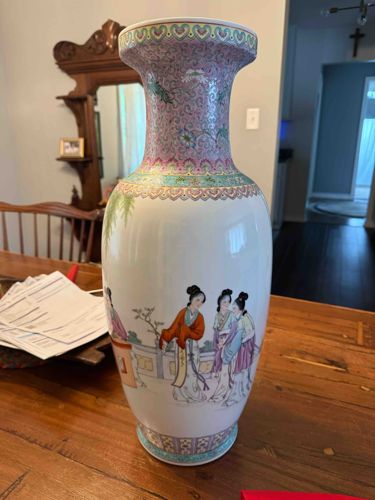
This is a large, hand-painted Chinese porcelain vase, likely a Ginger Jar or Baluster style, characterized by its wide body and slender neck. The vase stands tall, appearing to be at least 18-24 inches in height, with a substantial cylindrical form that tapers gracefully towards the foot and flares out slightly at the rim. The primary material is high-quality white porcelain, exhibiting a smooth, glossy glaze. Its artistic decoration is predominantly in the Famille Rose palette, featuring soft pastel shades. The lower body of the vase depicts a scene with several female figures, likely 'Gu-feis' or maidens, dressed in traditional flowing robes of pink, blue, purple, and orange, standing by a railing in a garden setting, with a stylized tree branch extending from the left. This central motif is framed by ornate bands. The shoulder and neck of the vase are adorned with intricate, repeating patterns in a vibrant, almost iridescent purple, accented with green and gold details, along with what appear to be subtle floral or avian motifs. A delicate border of pink stylized hearts or scrolls encircles the top rim. The craftsmanship suggests hand-painting, given the nuanced details and variations in brushwork. The condition appears excellent, with no visible chips, cracks, or significant wear to the glaze or paint, suggesting it has been well-preserved or is a more recent production. The vibrant colors and detailed artistry indicate a piece of considerable decorative quality. Without a visible maker's mark or signature, a precise age is difficult to determine, but the style is reminiscent of 20th-century Chinese export porcelain, possibly Republic Period or later, though traditional themes often persist through various eras.
AI Appraisal Report
Upon visual examination of the provided images, this large Chinese porcelain vase, decorated in the Famille Rose style, presents as a piece of considerable decorative merit. Standing approximately 18-24 inches, its baluster form is well-proportioned and the porcelain appears to be of high quality with a consistent, glossy glaze. The main decorative panel, featuring maidens in a garden, is skillfully hand-painted, displaying a soft yet vibrant palette typical of the Famille Rose tradition. The intricate patterns on the neck and shoulder show good attention to detail.
The condition appears excellent from the images, with no visible chips, cracks, or restoration. However, the precise age and origin are difficult to ascertain. While it evokes styles from the Republic Period (1912-1949), the vibrant, almost flawless coloration and pristine condition could also indicate a high-quality 20th-century reproduction made for export. The market for such pieces is active, but values differentiate significantly between period works and later decorative wares. Similar large, decorative 20th-century Famille Rose vases typically sell in the auction market for several hundred to over a thousand dollars, depending on artistry and provenance.
A definitive authentication is impossible from images alone. An in-person examination is required to assess the physical characteristics of the porcelain paste, the footrim for signs of natural wear, the quality of the enamels under magnification, and to search for any reign marks or maker's signatures, which were not visible. Without provenance or physical inspection to confirm a Republic Period or earlier origin, the vase must be conservatively valued as a high-quality decorative piece.