These notes were written by the person who submitted this item. Appraiser.AI has not verified them, and the AI's identification and estimate may rely on them.
AI Estimated Value
Not an official valuation
$2,800 - $5,500
AI estimate as of August 16, 2025 · verify with a professional before acting
AI-Generated · Verify before acting
Everything on this page is generated by AI for informational purposes only. AI can make mistakes — the AI may misidentify items or misattribute them (artist, maker, brand, designer, origin, era). This is not an official valuation and should not be used for insurance, sale, tax, estate, legal, or lending purposes — or any decision requiring a certified appraisal. It is not an authoritative claim about any person, brand, or rights holder — do not share or rely on it as a factual statement about a third party. Always consult qualified professionals before making financial decisions.
This analysis also relies on unverified notes provided by the user, which may be incomplete or inaccurate and could affect the result.
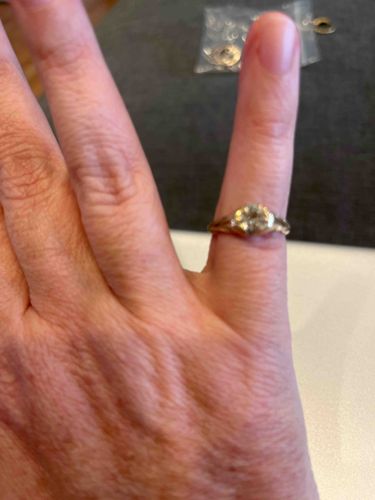
The item is a diamond solitaire ring, appearing to be crafted from yellow gold or a similar warm-toned metal. The central stone is a round brilliant-cut diamond, held securely by what appears to be a six-prong setting, although the exact number of prongs is not perfectly clear from the image. The diamond exhibits a warm, perhaps slightly yellowish tint, suggesting a lower color grade, though this could also be influenced by lighting conditions or the metal's color reflecting into the stone. The stone's approximate diameter appears to be around 6-7mm, which would correlate to a weight of approximately 0.75 to 1.25 carats, depending on its cut and depth. The band of the ring appears to have some subtle decorative detailing, possibly engraved or carved elements on the shoulders, though these details are not sharply in focus. The overall construction suggests a classic, traditional solitaire design. There are no clear visible condition issues such as major scratches, dents, or missing prongs, and the metal shows a soft sheen consistent with regular wear, possibly with some light surface abrasions or a developing patina. No clear maker's marks or signatures are discernible from the image. Given the classic solitaire design and the apparent style of the band, the ring could date anywhere from the mid-20th century to a more contemporary period, with a style that often transcends specific eras. The craftsmanship appears to be of good quality, providing a secure setting for the prominent central diamond.
AI Appraisal Report
I have carefully examined the provided image of the Yellow Gold Diamond Solitaire Ring, noting its classic design and prominent central diamond. The ring appears to be crafted from yellow gold, featuring a round brilliant-cut diamond secured by what seems to be a six-prong setting. The diamond itself exhibits a warm tint, suggesting a lower color grade, which is a factor in its value, though lighting and the metal's color reflection could influence this perception. Based on its approximate diameter of 6-7mm, I estimate the diamond to weigh between 0.75 and 1.25 carats. The band shows subtle decorative detailing on the shoulders, adding to its traditional aesthetic.
From the visual evidence, the ring appears to be in good overall condition, with no visible major damage such as chips, cracks, or missing prongs. The metal displays a soft sheen consistent with regular wear, possibly indicating light surface abrasions due to its age and use. The craftsmanship appears solid, providing a secure setting for the stone.
In terms of market conditions, classic solitaire diamond rings remain consistently in demand. The warm tone of the gold and the diamond's color suggest a timeless piece that appeals to a broad demographic looking for traditional engagement or anniversary jewelry. While not exceptionally rare, the quality of cut and clarity, which cannot be definitively assessed from the image, would determine its position within the market for similar items.
Several factors significantly impact value: the diamond's exact carat weight, its precise color and clarity grades (which are impossible to ascertain fully from an image), and the quality of the gold. The apparent warmth of the diamond likely places it in the J-M color range, which would typically command a lower price than colorless diamonds.
Limitations of visual examination are significant. Without physical inspection, I cannot verify the diamond's authenticity as natural, nor can I accurately grade its color, clarity, or exact carat weight with precision. I also cannot confirm the metal purity or identify any potential maker's marks, which would influence authenticity and provenance. For a full authentication and precise valuation, an in-person examination by a certified gemologist using specialized equipment for detailed grading, along with potential scientific testing (such as spectroscopy for diamond origin), and any available provenance documentation, would be absolutely necessary.