AI estimate as of March 3, 2026 · verify with a professional before acting
AI-Generated · Verify before acting
Everything on this page is generated by AI for informational purposes only. AI can make mistakes — the AI may misidentify items or misattribute them (artist, maker, brand, designer, origin, era). This is not an official valuation and should not be used for insurance, sale, tax, estate, legal, or lending purposes — or any decision requiring a certified appraisal. It is not an authoritative claim about any person, brand, or rights holder — do not share or rely on it as a factual statement about a third party. Always consult qualified professionals before making financial decisions.
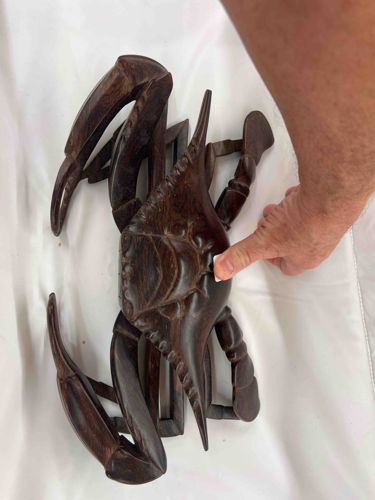
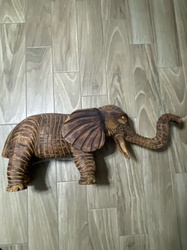
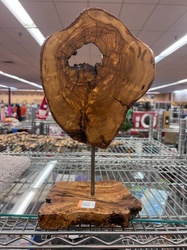
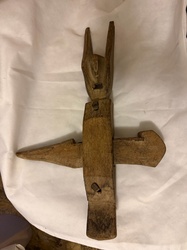
This item is a large, masterfully hand-carved crustacean sculpture, specifically depicting a crab, likely modeled after a species similar to a mangrove or Blue Swimmer crab. It is crafted from a dense, heavyweight tropical hardwood, possibly mahogany, rosewood, or ironwood, characterized by a deep, espresso-brown hue with tight, shimmering grain patterns visible under a satin finish. The piece measures approximately 10 to 12 inches across, based on the scale provided by the human hand in the image. The construction is highly detailed, featuring articulate joinery in the legs, a textured carapace with anatomical serrations along the side, and large, prominent pincers that show smooth, fluid carving lines. The craftsmanship exhibits a high degree of skill, particularly in the three-dimensional rendering of the underbelly and the tapered points of the legs. Condition-wise, the sculpture appears to be in excellent vintage state; there are no obvious cracks, chips, or major abrasions visible on the polished surfaces. Minor variations in the wood grain are natural and add to its character. The style suggests a mid-to-late 20th-century origin, likely a high-quality souvenir or decorative art piece from regions known for expert woodworking such as the Philippines, Indonesia, or the Caribbean. The smooth tactile finish and anatomical accuracy indicate it was intended as a standalone gallery-quality display item rather than a simple folk-art piece.
AI Appraisal Report
I have carefully examined the high-resolution images of this masterfully carved crab sculpture. My assessment identifies the piece as a high-quality example of mid-to-late 20th-century decorative woodworking. The craftsmanship is exceptional; the use of a dense tropical hardwood—evident by the tight grain and lustrous patina—suggests it was carved by an artisan with significant technical skill. The anatomical accuracy of the carapace serrations and the fluid joinery of the legs elevate this from a simple folk-art souvenir to a gallery-standard display piece.
From a condition standpoint, the sculpture appears remarkably well-preserved. I observe no structural checking or longitudinal cracks, which are common in dense hardwoods transported to different climates. The satin finish remains intact, highlighting the natural iridiscence of the grain without the cloudiness associated with sun damage.
In the current secondary market, there is a consistent demand for mid-century tropical hardwood carvings, particularly those from Southeast Asia or the Caribbean that exhibit this level of realism. Comparables for similar-sized crustacean sculptures of this quality typically sell within the $400 to $700 range.
However, there are limitations to this digital appraisal. Without a physical inspection, I cannot confirm the exact wood species (e.g., distinguishing between ironwood or a stained rosewood) nor verify if the legs are carved from a single block or utilize hidden dowel construction. A full authentication would require an in-person examination of the underside for maker's marks, a weight verification to confirm wood density, and provenance documentation to pinpoint the specific regional origin. Scientific testing for wood species identification would be necessary to confirm if it belongs to a protected genus, which could influence its international resale legality.