AI estimate as of June 22, 2025 · verify with a professional before acting
AI-Generated · Verify before acting
Everything on this page is generated by AI for informational purposes only. AI can make mistakes — the AI may misidentify items or misattribute them (artist, maker, brand, designer, origin, era). This is not an official valuation and should not be used for insurance, sale, tax, estate, legal, or lending purposes — or any decision requiring a certified appraisal. It is not an authoritative claim about any person, brand, or rights holder — do not share or rely on it as a factual statement about a third party. Always consult qualified professionals before making financial decisions.
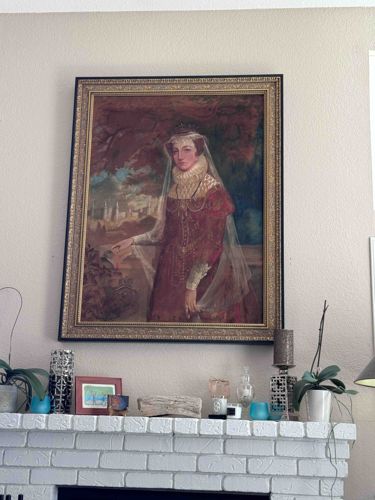
The item is a framed oil painting depicting a portrait of a female figure, likely a noblewoman or royalty, given her attire and adornments. The painting is rectangular, set in a substantial ornate gold-toned frame with intricate raised scrollwork and beaded detailing along the inner and outer edges, suggesting a high-quality, possibly antique, framing. The portrait features a woman with light skin and dark hair, wearing a rich, red or burgundy gown with elaborate gold embroidery and white lace or ruffled trim at the cuffs and around the high neck. She wears a large, prominent ruff collar that appears to be multiple layers of white lace or pleated fabric. A delicate, sheer white veil cascades from her head, possibly adorned with a small crown or circlet, typical of European aristocratic fashion from the Renaissance or early Baroque period. She holds her left hand lightly on a stone balustrade or ledge, while her right hand is partly obscured, possibly resting on her skirt. The background reveals a stylized landscape with trees in deep red and brown tones, suggesting an autumnal or idealized setting, and in the distance, a cityscape with various buildings and spires under a pale blue sky. The brushstrokes appear painterly and somewhat visible, indicating it is an original work rather than a print. The colors are rich and somewhat subdued, which could be due to age, varnish yellowing, or the artist's palette choice. There are no immediately obvious signs of damage such as tears, significant cracks, or extensive paint loss visible from this distance, though the painting may benefit from a professional cleaning and conservation to enhance its vibrancy and address any potential accumulated dirt or old varnish. The overall aesthetic suggests a portrait in the style of Old Masters, possibly dating from the 17th or 18th century, or a later reproduction or homage in that style. The craftsmanship of both the painting and the frame indicates a piece intended for formal display.
AI Appraisal Report
This framed oil painting depicting a noblewoman presents as an Old Master style portrait, potentially dating from the 17th or 18th century, or a later homage. Visually, the canvas appears to be in good condition with no overt signs of significant damage like tears or extensive paint loss. The rich colors, painterly brushstrokes, and period attire suggest an original work. The ornate gold-toned frame is a high-quality, likely antique piece, complementing the painting's historical aesthetic.Market conditions for Old Master style paintings vary widely based on artist attribution, provenance, and condition. Without an artist's signature or documented history, this piece would be considered a decorative work. Demand exists for well-preserved, period-style portraits that enhance classic interiors. Rarity is difficult to assess without knowing if this is a unique creation or part of a series.Key factors impacting value are the lack of definitive artist attribution or provenance, which significantly limits its collectibility beyond decorative appeal. Should it be an authentic work by a recognized artist, its value could escalate considerably.Limitations: Authenticity cannot be definitively verified from images alone. A physical examination is crucial to assess paint layers, canvas age, stretcher marks, and detect any potential restorations or overpainting. Scientific testing (e.g., pigment analysis, carbon dating of canvas) would be necessary for full authentication. Provenance documentation (prior ownership history) would also immensely boost its value.Without physical examination and further verification, I estimate this piece based on its visual appeal as a high-quality decorative item.