AI estimate as of September 8, 2025 · verify with a professional before acting
AI-Generated · Verify before acting
Everything on this page is generated by AI for informational purposes only. AI can make mistakes — the AI may misidentify items or misattribute them (artist, maker, brand, designer, origin, era). This is not an official valuation and should not be used for insurance, sale, tax, estate, legal, or lending purposes — or any decision requiring a certified appraisal. It is not an authoritative claim about any person, brand, or rights holder — do not share or rely on it as a factual statement about a third party. Always consult qualified professionals before making financial decisions.
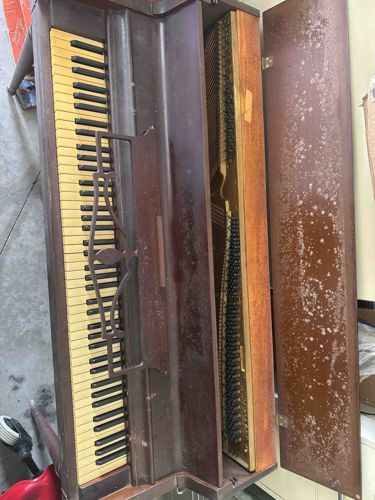
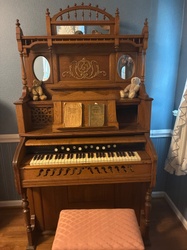
This item is a vintage spinet piano, characterized by its compact size and upright design. The casing appears to be constructed from wood, likely a dark stained hardwood, exhibiting a deep brown hue. The finish on the exterior, particularly on the right side panel which is open, shows significant signs of age and wear, including widespread white-ish splotches indicative of moisture damage, mold, or severe finish degradation. The keys are a mix of ivory-colored naturals and black sharps, with the naturals showing discoloration and yellowing consistent with age or previous exposure. A decorative, possibly cast iron or carved wooden, music stand is integrated above the keyboard, featuring an ornate, flowing design. Internally, the piano reveals its string and hammer mechanism, with the strings appearing in rows and the tuning pins visible. The soundboard, made of lighter wood, is also visible. The piano looks to be missing its kickboard/bottom front panel. The overall condition suggests it has been stored in a less than ideal environment, leading to both cosmetic and potential structural/functional issues. Given its design and visible characteristics, it likely dates from the mid-20th century, possibly 1940s-1960s, a period when spinet pianos were popular for their space-saving qualities. Craftsmanship appears standard for mass-produced pianos of that era, though signs of neglect currently overshadow any immediate indicators of superior quality.
AI Appraisal Report
Based on my visual examination of the provided image, this vintage spinet piano presents significant challenges regarding value. The compact size and upright design are typical of spinet pianos, popular in the mid-20th century (likely 1940s-1960s) for their space-saving appeal. The dark-stained wooden casing exhibits severe finish degradation, indicated by extensive white splotches, especially on the exposed right side panel. This strongly suggests prolonged exposure to moisture, mold, or extreme environmental conditions, raising concerns about the integrity of the wood and internal components. The ivory-colored natural keys are discolored and yellowed, as expected with age, while the integrated, ornate music stand appears consistent with the era. Internally, the visible strings and hammers suggest the mechanism is present, but their functional condition is undeterminable from the image. A major red flag is the missing kickboard/bottom front panel, which is a structural and aesthetic detraction.
Market conditions for vintage spinet pianos are generally very soft. Due to their mechanical complexity, susceptibility to environmental damage, and the high cost of transportation and repair, many are considered 'free-to-good-home' items or even disposal burdens. Comparables in similar neglected conditions often sell for minimal amounts, sometimes just their scrap value, if they can be sold at all. Demand is extremely low unless they are in exceptional cosmetic and playing condition, or a rare, historically significant model. This particular piano's severe cosmetic damage and apparent neglect significantly impact its value downwards. The cost of restoring the finish and potentially repairing internal mechanisms would far exceed its market value, making it economically unfeasible for most buyers. Rarity is not a factor here; spinet pianos were mass-produced.
Without an in-person examination, I cannot definitively assess the structural integrity of the soundboard, the condition of the pin block (critical for tuning stability), the responsiveness of the hammers and keys, or the presence of pests. Authenticity of the age is visually supported, but full authentication would require physical inspection of serial numbers and internal markings, as well as an assessment by a qualified piano technician to determine playability and repair costs. My valuation reflects its current condition as a heavily damaged, non-functional (likely) decorative piece, or one requiring extensive and costly restoration.